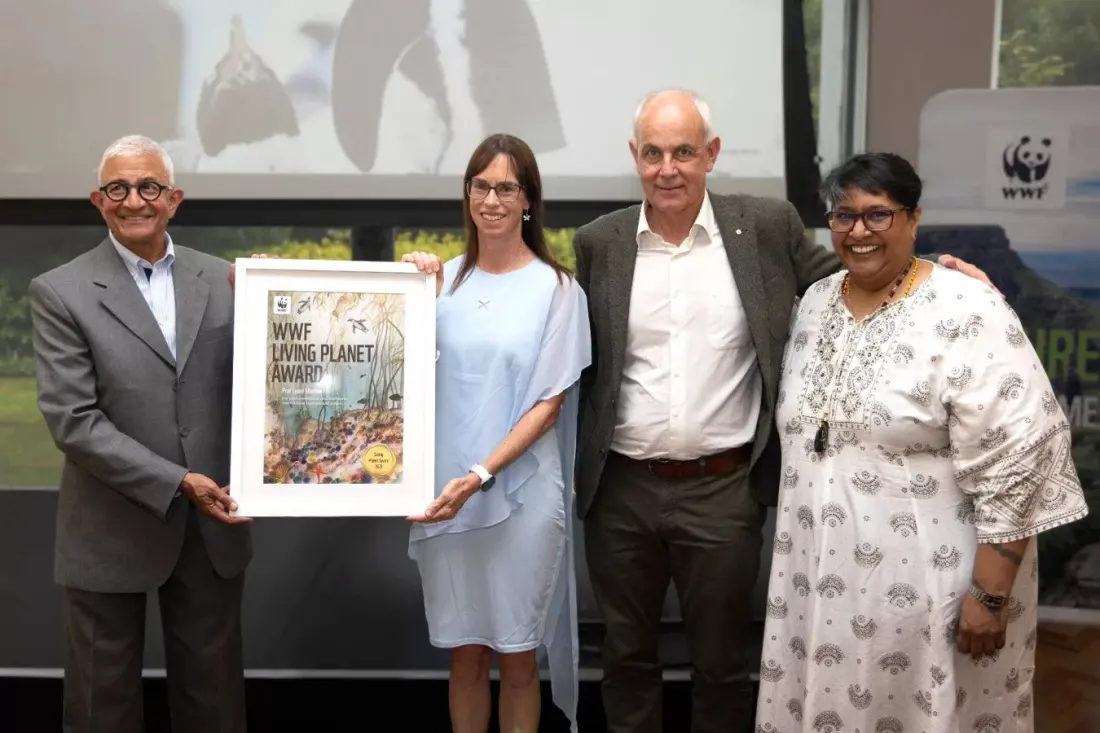
Professor Lynne Shannon, a Cape Town-based marine scientist at the University of Cape Town, has been awarded WWF South Africa's 2026 Living Planet Award. The honour was presented at WWF South Africa's annual general meeting on 13 November and recognises decades of work on marine conservation, sustainable fisheries and the way climate change is reshaping ocean ecosystems.
Shannon sits in UCT's Department of Biological Sciences and is Deputy Director of the Marine and Antarctic Research for Innovation and Sustainability (MARiS) Centre. Much of her research centres on the Benguela marine ecosystem — the cold, nutrient-rich current system running along South Africa's west coast that underpins some of the country's most productive fisheries. Her ecological models of that system have directly informed how South Africa manages its pelagic fisheries and how conservationists approach protecting the African penguin.
The penguin connection is one of the most tangible strands of her work. African penguins rely heavily on sardines and anchovies, and Shannon's research maps that dependence within the wider Benguela food web. It's a clear illustration of how the health of fish stocks, fishing policy and the survival of an endangered seabird are all linked — when sardine and anchovy populations dip, penguins feel it immediately.
Shannon has also been central to the science behind WWF's Southern African Sustainable Seafood Initiative (WWF-SASSI), the programme that helps South African consumers and restaurants choose seafood caught sustainably. She has served on fishery assessment panels, supplying the evidence base that determines which species end up on the green, orange and red lists.
WWF CEO Dr Morné du Plessis said Shannon was chosen for her scientific excellence in advancing marine conservation and her contribution to WWF-SASSI. The organisation also noted her role advocating ecosystem-based ocean management in what has traditionally been a male-dominated field.
The Living Planet Award is not her first international nod. In 2025 Shannon became the first South African to receive the Prince Albert Grand Medal in Oceanography, presented in Paris for lifetime contributions to marine science.
Why should travellers care? Because the seafood you eat on a South African holiday, the penguin colonies you visit at Boulders Beach or Stony Point, and the health of the coastal waters you swim in all trace back to the kind of research Shannon does. WWF-SASSI's sustainable seafood guidance — strengthened by her panel work — is a practical tool any visitor can use when ordering linefish or snoek at a harbourside restaurant. Recognition like this also signals that South Africa's marine science community is punching well above its weight, and that the country's ocean management decisions are grounded in solid, local evidence.
For anyone planning a trip along the Cape coast, Shannon's work is a reminder that the Benguela ecosystem is a living system under pressure — and that choosing sustainably caught fish and supporting penguin conservation efforts while travelling genuinely makes a difference.
Story via Getaway South Africa.