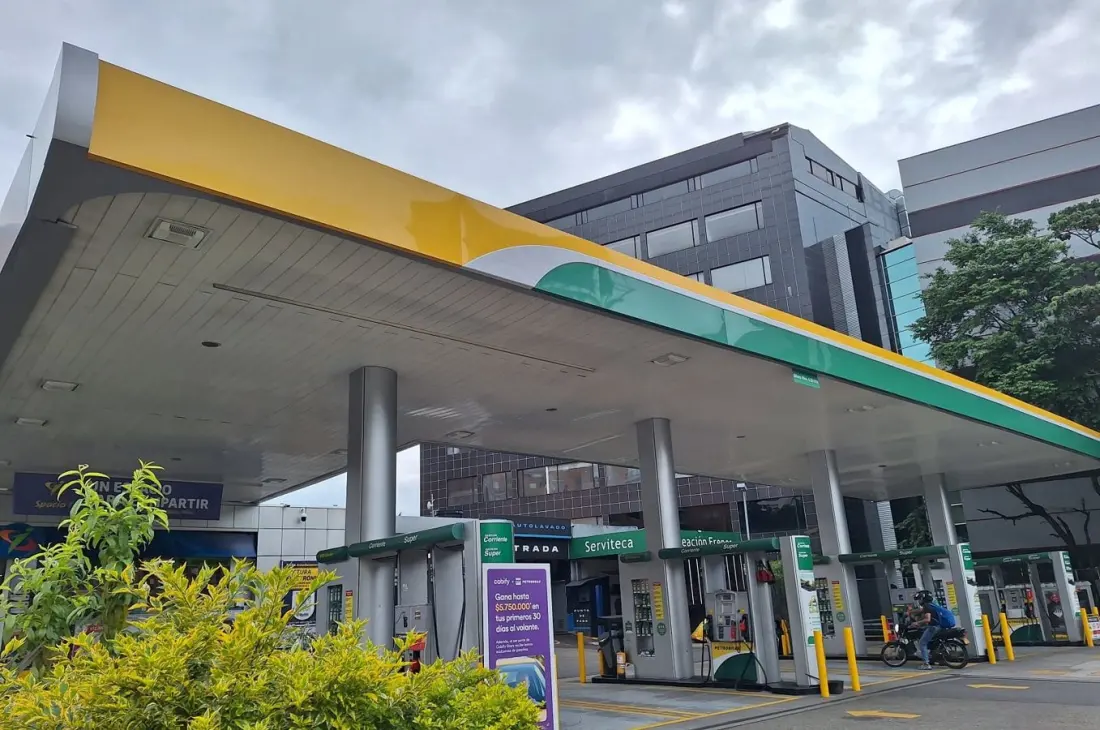
Petrol and diesel prices in Colombia are staying put — and that's good news for anyone filling a rental tank or hopping on a long-distance bus. The catch is that someone has to pay for the gap between what fuel actually costs on world markets and what Colombians pay at the pump. That someone is the state, and the tab is running at roughly 9.7 trillion pesos, just over US$3 billion a year.
The squeeze is sharpest on diesel. Between January and late September, the international benchmark price jumped 67%, according to the think tank Anif. Colombian pump prices moved just 3% over the same stretch. The difference gets absorbed by the Fuel Price Stabilization Fund (FEPC), a mechanism that compensates for the shortfall and has become one of the biggest drains on the public budget. In September, the average gap hit 7,780 pesos per gallon — the widest of the year.
The freeze, ordered by President Abelardo de la Espriella's government, started with diesel in September and October, a response to the August 10 earthquake. It then expanded: a planned 0.29% rise in regular gasoline — tied to an updated price paid to ethanol producers — was scrapped, keeping petrol at September's average level. That reversal alone costs the government about 8.3 billion pesos (around US$2.6 million) for October's ethanol payment.
The numbers get bigger fast. The Colombian Oil and Gas Association estimates the fund's accumulated deficit could approach 6 trillion pesos by the end of 2026. There's a knock-on effect too: state-controlled Ecopetrol sells the subsidised fuel and waits up to a year for reimbursement, which strains its cash flow and raises financing costs.
For travellers, the practical upshot is simple: getting around Colombia remains cheap relative to most of the world. Diesel powers the trucks and buses that move almost everything in the country, so frozen prices keep intercity bus fares and, indirectly, food costs in check. Road-tripping the Coffee Axis or the Caribbean coast stays budget-friendly for now.
But the arrangement looks shaky. The 2027 draft national budget plans to cover the fund's obligations out of current revenues rather than borrowing, even as the government tries to shrink a fiscal deficit. Economists warn the diesel subsidy is hard to sustain, yet any sharp correction would feed straight into transport and grocery prices. The debate, as it stands, is less about what Colombians pay at the pump and more about how long the state can keep paying instead of them. If international prices stay high, expect eventual adjustments — and with them, modest knock-on effects on the cost of travelling through the country.