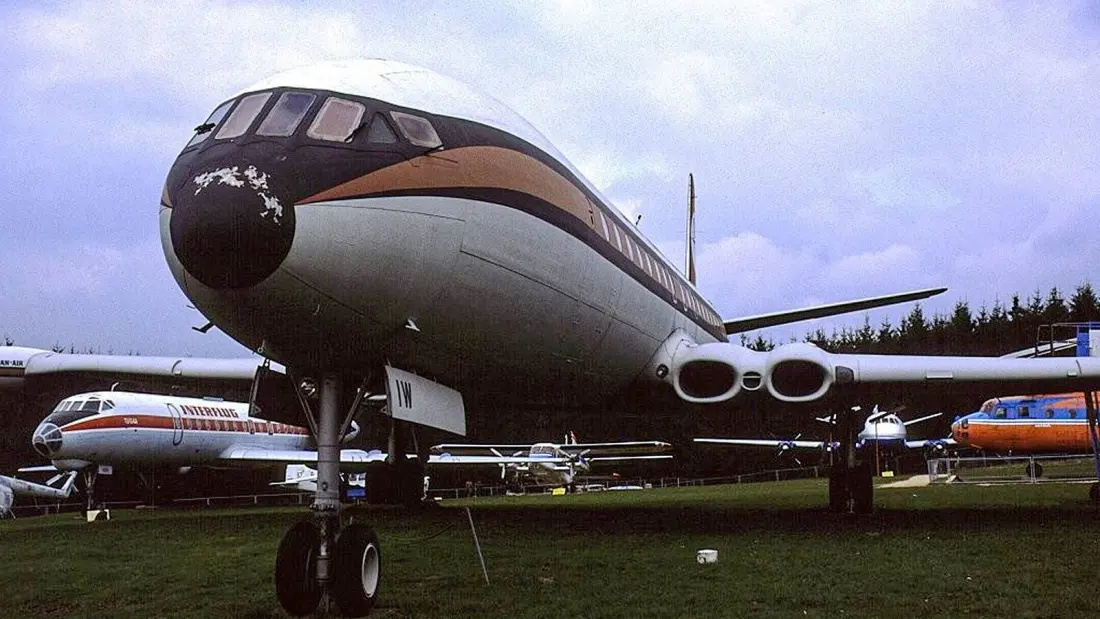
Most air travellers assume the Boeing 747 invented the four-engine jet. It didn't. That honour goes to the de Havilland Comet, the sleek British airliner that entered service with BOAC in May 1952 and quietly started the entire commercial jet age — decades before the 747 carried its first passenger.
The Comet was a sensation in its day. It cruised above 450 mph at 35,000 feet, roughly double the altitude of the piston airliners it replaced, with a cabin so smooth and quiet that flying stopped feeling like a bumpy sea crossing. To do it, de Havilland's chief designer Ronald Bishop wrapped four de Havilland Ghost turbojets inside remarkably thin aluminium skin — as little as 0.028 inches thick — to save weight.
Then came the disasters. In 1954, after crashes including BOAC Flight 781, investigators at RAE Farnborough found the real culprit wasn't the famously blamed square windows, but microscopic cracks triggered by repeated cabin pressurisation, starting near an antenna hatch cut-out. Cheap punch-countersunk rivet holes in the thin skin had created invisible stress points. The fleet was grounded, and Britain's head start in jet travel effectively evaporated.
The redemption arc is the interesting part. The redesigned Comet 4, powered by four Rolls-Royce Avons, beat Pan Am's Boeing 707 across the North Atlantic by three weeks, launching the first commercial jet transatlantic service between London Heathrow and New York on 4 October 1958. It then flew for years without a single pressurisation or structural failure. But four years of groundings had cost de Havilland the market: the Comet carried around 81 passengers against the 707's 181, and only 113 Comets were ever built versus more than 1,000 707s. American manufacturers won the volume game, and the rest is aviation history.
Why should a holidaymaker care? Because every safe long-haul flight you take today rests on lessons from the Comet crashes. The fail-safe design principles, fatigue inspections and crack-stopping structures mandated after the Farnborough inquiry became the global template — baked into everything from the 747 to today's composite airliners. And the Comet's story is woven into British aviation heritage: you can still see preserved airframes around the UK, from the de Havilland Aircraft Museum near the old Hatfield factory site to exhibits elsewhere in England, a nice detour for anyone with a stopover in London and an interest in how modern flying began.