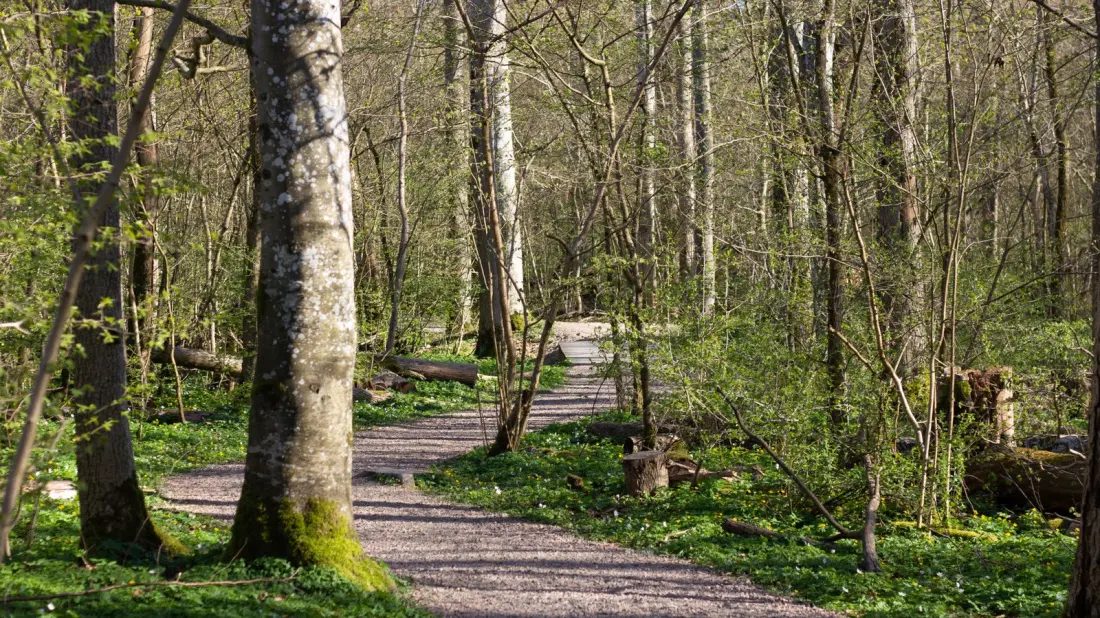
Some national parks make up for in atmosphere what they lack in size. Dalby Söderskog in southern Sweden covers roughly 0.1 square miles — making it not just Sweden's smallest national park but likely the smallest in all of Europe — yet it protects one of the last remnants of the region's pre-industrial broadleaf forest. For anyone road-tripping through Skåne County, it's an easy and surprisingly rewarding stop.
The park sits about 12 miles southeast of Lund, deep in Sweden's fertile, urbanised south rather than the vast wildernesses of the Arctic north. That's precisely what makes it special: amid centuries of farming and development in Skåne, this little patch of ancient oaks, beeches and elms survived largely untouched. Established in 1918, it's also among Sweden's oldest national parks. Researchers later found traces of livestock grazing and cultivation from earlier centuries, but the forest still reads as a window into how southern Sweden's woodlands looked long before the modern era.
Inside, the canopy feels almost cathedral-like, with mosses and ferns carpeting the ground and a spring wildflower display worth timing a trip around. Birdlife is a highlight too — the park punches above its weight for wildlife spotting, especially for such a compact site. An ancient stone wall encircles the forest, adding a touch of quiet, layered history to a wander that already feels timeless.
Hiking here is low-effort, high-reward. There are around four miles of trails in total, mostly flat and easy, so this suits families and casual walkers as much as keen hikers. The main Dalby Söderskog Loop runs about a mile and a half from the parking area around the forest's perimeter, passing trees at every stage of life and decay, with interpretive signs explaining the forest's history and ecology. Want more? The roughly two-mile Dalby Norreskog Loop continues into the adjacent Dalby Norreskog Nature Reserve, while the 2.2-mile Skryllestigen Trail links the park to Naturum Skrylle, a nature centre with indoor and outdoor exhibits on local ecology, geology and cultural history.
Why should this be on your list? Because it delivers a genuinely old-growth forest experience without any expedition planning. You can base yourself in Lund or Malmö, reach the park with a short drive, walk its trails in a morning, and still have the afternoon for Skåne's towns, coastline or cafés. It's the rare national park visit that fits neatly inside a city-break itinerary.
Islands