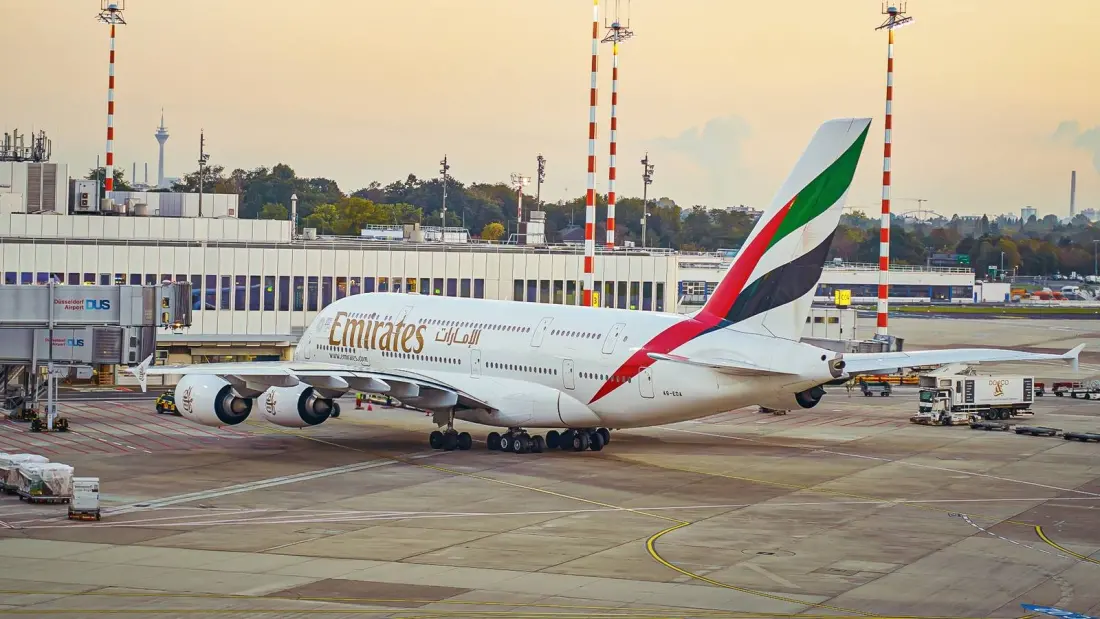
At roughly 8,800 miles, the nonstop hop between Dubai and Auckland is Emirates' longest Airbus A380 route and one of the longest commercial flights on the planet. Launched in March 2016, it regularly clocks in at over 17 hours, and headwinds across the Indian Ocean and Southeast Asia can push block times to around 17 hours 25 minutes on the westbound leg. When a flight lasts that long, there's no slack in the system: winds, payload, fuel reserves and the scarcity of diversion airports across vast ocean stretches all need to be weighed before every departure.
What's less well known is the safety net behind it. Since day one, Emirates has kept a parallel one-stop option to Auckland via its Australian gateways — Sydney, Melbourne and Brisbane — all served heavily from Dubai. If winds, demand or scheduling pressures force changes to the nonstop, passengers can still be routed through Australia using connections that already exist in the network. It's redundancy by design rather than emergency improvisation, and it also works in reverse: travellers from Europe, the Middle East, Africa and Asia connecting through Dubai have multiple ways to reach New Zealand, especially if Australia is part of their itinerary anyway.
Demand has been strong enough that Emirates upped the route to daily A380 service earlier this year — a statement of confidence given the costs of ultra-long-haul flying. But the airline hasn't abandoned the connecting model; the two approaches complement each other, letting planners shift capacity seasonally without losing New Zealand coverage.
The A380 remains central to all this. While most carriers have retired their double-deckers, Emirates flies 116 of them — the largest fleet anywhere — and keeps investing in refurbished premium cabins, lounges and shower spas, a real consideration when you're onboard for most of a day. For travellers, the practical takeaway is flexibility: book the nonstop if speed matters, or via Sydney, Melbourne or Brisbane if you want to break the journey, add an Australian stopover, or simply have more schedule options on one of aviation's most demanding routes.