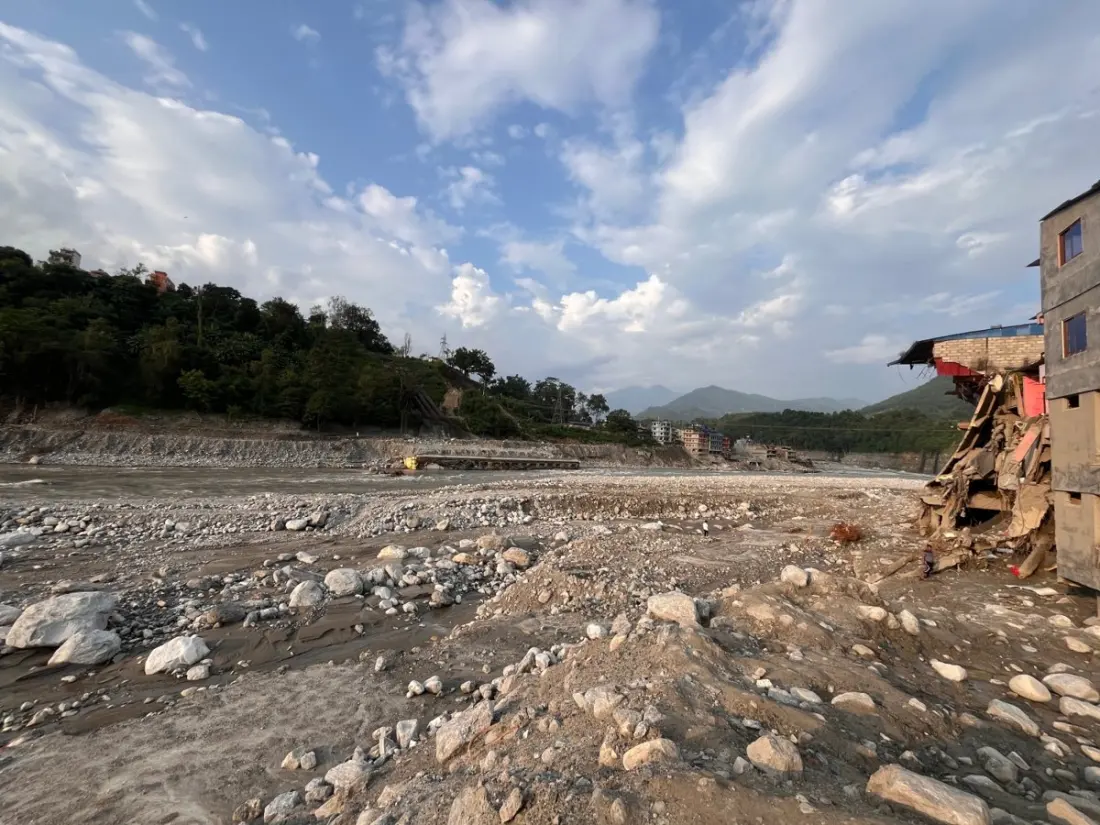
On 26 August, a river surge tore through Trisuli Bazar in Nepal's Nuwakot district, burying much of the town under mud, boulders and grey silt. The disaster killed more than 1,457 people across the region and roughly 5,500 are still listed as missing. The Trisuli river now flows some 30 metres above its former bed, and the three-storey powerhouse of the country's first big hydropower project sits buried under sediment.
Nepali Times has published a moving first-person account of a man returning to the town with his elderly father, who finished high school there more than fifty years ago. Back in March the father had wandered the bazar greeting old schoolmates, and promised to return for a longer visit. When he came back after the flood, his childhood town was gone. His old school, Trisuli Tribhuvan High School, had been flattened — only a cornice visible, with a Nepali flag planted nearby by survivors looking for something to hold on to.
The account captures both loss and survival. A resident's early phone warning — get the children out and run uphill — saved lives at the school, though the paths up were so jammed with fleeing students that one octogenarian had to be dragged past them by her daughter-in-law, up a nettled cliff and into a neighbour's car. The town's famously mixed community, where Muslim and Buddhist and Hindu neighbours shared festivals, iftar meals and street processions, lost many of its elders; the father spent the day after the flood calling friends, and never reached several of them.
Recovery is slow and uneven. Families are clearing rubble by hand, too impatient with tent life to wait for proper help. The story also flags an uncomfortable trend: people coming to photograph the devastation. Locals distinguish sharply between those who come to pray at the monastery and those treating the debris field as a spectacle — and the resentment is raw, especially from people still sleeping in tents who have lost everything while better-off neighbours relocated.
For anyone travelling in central Nepal, the practical takeaway is that this is an active disaster zone, not a sightseeing stop. Routes through Nuwakot and towards Rasuwa, including roads used for trips towards Langtang and the Trisuli river corridor, pass through or near affected areas. If your itinerary touches the region, check road status before setting out, respect closures, and treat any visit to damaged communities with the same care you would want in your own hometown — ask before photographing, support local businesses where they've reopened, and skip the debris fields entirely. Nepal's hill towns have rebuilt from disasters before, and respectful visitors will be welcome again — but the time to help is now, through donations and responsible travel, not snapshots.