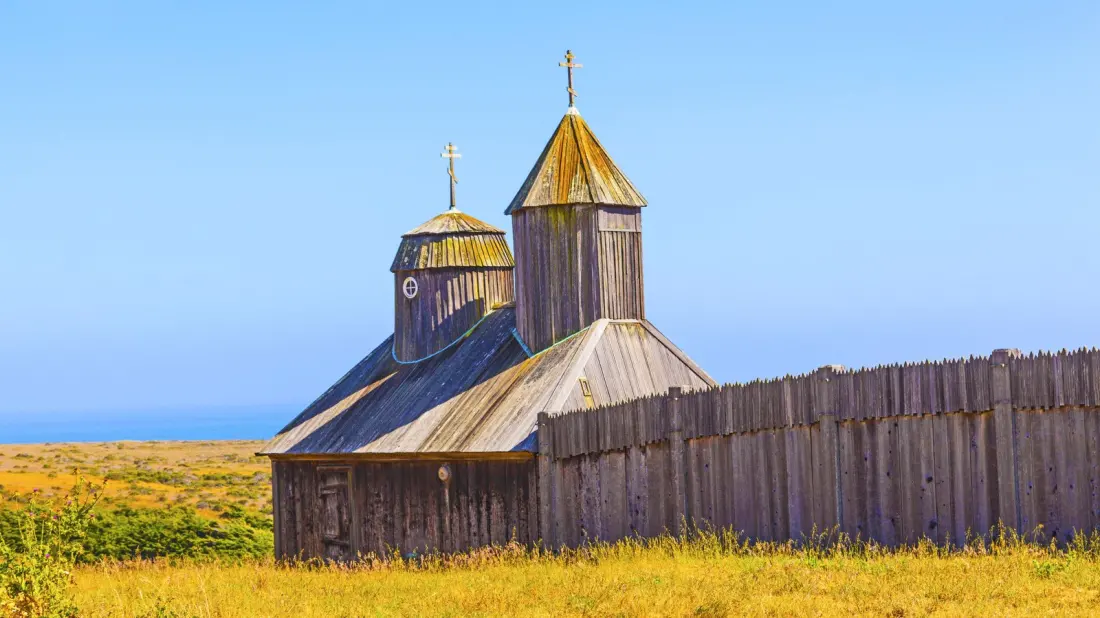
North of San Francisco, where Sonoma County meets the Pacific, sits a stockaded wooden fort with an unexpected backstory: for three decades it was the southernmost settlement of the Russian Empire. Fort Ross was founded in 1812 by a mixed expedition of Russians and Indigenous Alaskan Aleuts who sailed south from Russian Alaska to tap into California's fertile land and forests, and to trade with the Spanish colonists who then controlled much of the state. The venture never really thrived. After Mexican independence and a growing wave of American settlers, the Russians sold up in 1841 and left. Alaska itself followed a similar arc — colonised in 1741 and sold to the U.S. by Tsar Alexander II in 1867 for $7.2 million, roughly $166 million in today's money.
What makes the site special today is how multicultural that settlement was. Alongside Russians and Alaskan Alutiiqs, the fort's population included Native Kashaya Pomo people and even Hawaiians — an unusually blended community on the early 19th-century Pacific coast.
Fort Ross became a state historic monument in 1906 and is now run by California State Parks as Fort Ross State Historic Park. The site still wears its Russian heritage openly. There's a reconstructed Russian Orthodox church, a visitor centre with exhibits on the settlement's history, and Rotchev House, built by the fort's last Russian commander and reopened as a museum in 2010. History fans can also see a replica of what's said to be the first windmill built in California. Despite the towers and stockades, the fort never saw battle — it existed to guard the trading cove below, now known as Fort Ross Cove.
The park rewards time outdoors too. The rocky shoreline near the old Russian port is popular for rock fishing, and the tide pools are packed with sea stars, anemones, crabs and shellfish — great for kids. Clam Beach, true to its name thanks to its razor clams, offers a proper stretch of Californian sand. Just outside the fort walls is the historic orchard planted in 1814 to feed the colonists; its Capulin cherry tree dates to 1820, making it a living piece of the settlement.
For a full experience, camp overnight at Reef Campground just south of the fort. It's beautifully positioned above the beach, handy for surfing, diving and fishing, with hiking trails nearby that are good for spotting whales. Fair warning: it's rustic. There are 20 first-come, first-served pitches and chemical toilets, but no running water or RV hookups — come self-sufficient.
Fort Ross suits a specific kind of traveller: road-trippers working the northern stretch of the Pacific Coast Highway, history lovers after a story most visitors to California never hear, and coastal campers who like their scenery with a side of unexpected heritage. It's about an hour and a half's drive from Santa Rosa and roughly two and a half hours from San Francisco, making it an easy day trip or a weekend stop from the Bay Area. Charles M. Schulz–Sonoma County Airport is the closest, just over an hour away, with the big international options at Oakland and San Francisco both under two and a half hours by car.
Story via Explore.com.