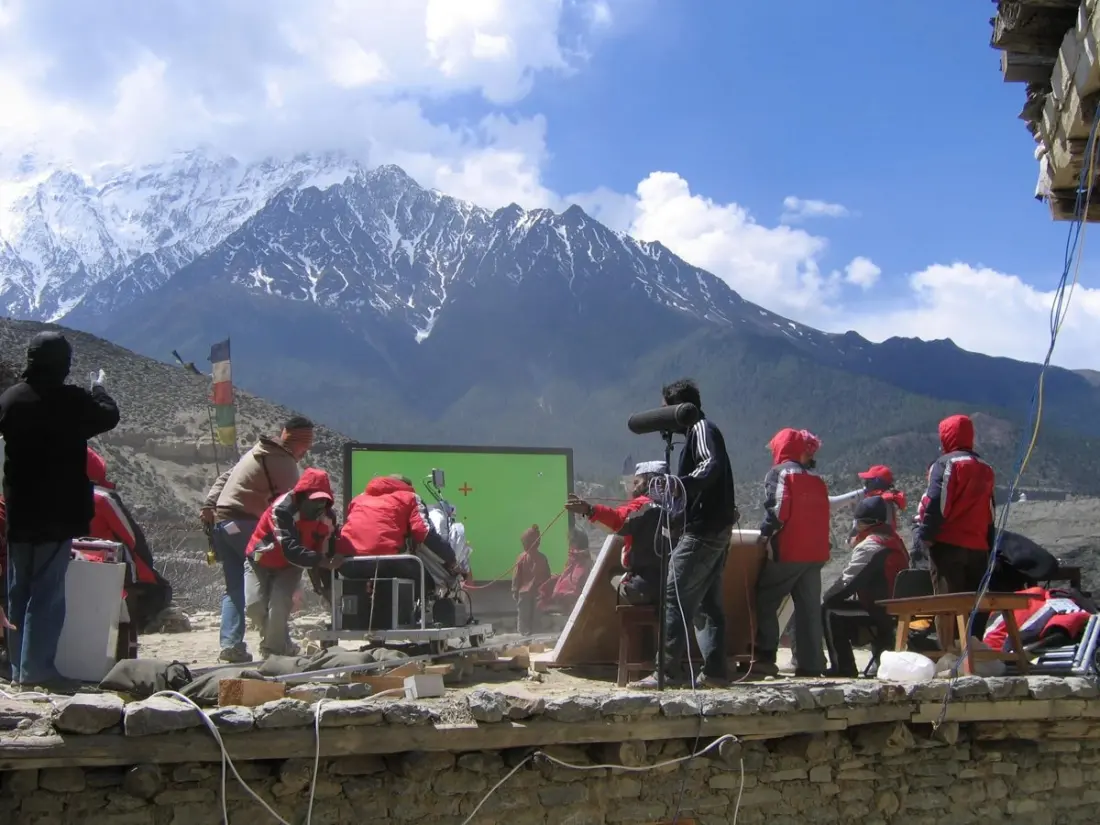
A 108-inch television, airlifted by cargo helicopter to a roadless village in Mustang, then carried the rest of the way by hand. That was the reality behind a Panasonic commercial shot against the peaks of Mt Nilgiri — and it says a lot about what it takes to film in Nepal.
The country has quietly played host to some ambitious productions. In 2006, Coca-Cola Germany needed an international-standard football pitch on a remote Mustang plateau for a Powerade spot tied to that year's FIFA World Cup. There were no roads, so everything arrived on foot, by mule train or by helicopter. Fifty-four European footballers joined twelve players from a fictional African United side, plus Nepal's own A and B Division players and roughly 350 extras. More than 550 people camped on site for over a week while snow fell daily — crews dug out their tents each morning before shooting could begin. Medics stayed around the clock with oxygen on standby, and planners even accounted for the chance of a match ball rolling off the cliff edge into the Kali Gandaki valley below.
Not every shoot is that extreme. A Nippon Paint commercial shuttled more than 200 crew and 400 extras between Bhaktapur and Patan Durbar Squares in a single day, with lighting specialists brought in from India and over ten days of restoration work at the two heritage squares beforehand.
The pitch of the story, from Nepali Times, is that Nepal has the locations but not yet the systems. Filming permissions still bounce between government offices, often ferried by hand by producers or local coordinators. The country's Motion Picture Rules already provide for a One Door Committee meant to consolidate foreign filming permits — the writer argues it just needs to function as a real service, with a single digital application, tracking, published timelines and a 48-hour target for routine approvals. India's national single-window portal, which lists 475 production resources across 36 states and territories, is held up as the model. There's also a training gap: talented local crew struggle to get the credits and on-the-job mentoring that international producers demand.
Why should a traveller care? Partly because the spectacle is real — Mustang's high desert, backed by Nilgiri and the deep gorge of the Kali Gandaki, is genuinely one of Asia's most striking filming and trekking locations. And partly because smoother filming logistics mean more productions, better infrastructure and more income in remote regions that tourists also love. The villages, squares and plateaus doubling as football grounds and TV sets are the same places you can visit — Jomsom, Muktinath, Bhaktapur's Durbar Square among them.
Story credited to Nepali Times.