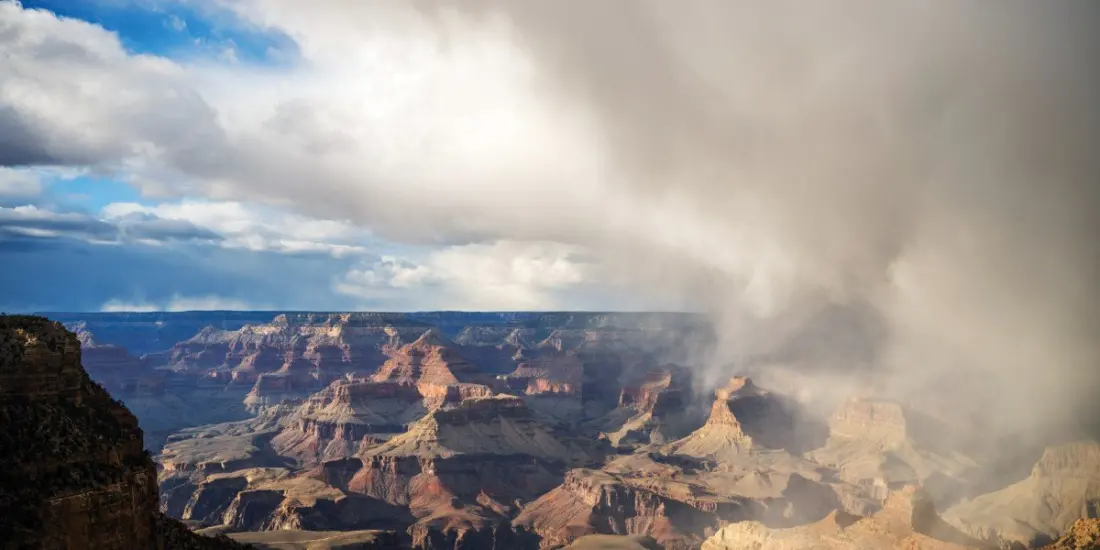
The Grand Canyon doesn't need much introduction, but it's having a moment right now. The National Park Service is marking a century of stewardship, Route 66 turns 100 this year, and the US is celebrating its 250th birthday. Better still, crowds are a little thinner than usual, which means easier hotel bookings and quieter overlooks at one of the world's most famous views: a chasm 277 miles long, up to 10 miles wide and more than a mile deep, exposing nearly two billion years of rock. Note that the North Rim is still recovering from wildfires, so the South Rim is the place to base yourself.
Skip the car and take the train. The Grand Canyon Railway leaves Williams, Arizona every morning and takes about two hours to roll through prairie and ponderosa forest up to the Kaibab Plateau. It's part time machine, part theme park: restored Pullman coaches, luxury parlor cars serving sparkling wine and charcuterie, wandering musicians, and actors playing bandits. Bags checked at the Grand Canyon Railway Hotel in Williams appear at the South Rim on arrival, and the train deposits you steps from the canyon edge. In winter, the same railway runs a Polar Express package — hot chocolate, cookies, Santa boarding mid-journey — that turns the ride into a family Christmas event.
Drivers coming from California can follow Route 66 east through the Mojave to Williams, arguably the best-preserved Route 66 town in America: neon signs, chrome-counter diners, classic cars, and festivals and car shows marking the highway's centenary.
Once at the rim, linger. Five viewpoints worth planning around: Hopi Point for sunset drama, Mohave Point for glimpses of the Colorado River far below, Lipan Point for side-canyon sweeps, Hermits Rest for Mary Colter's rustic stone architecture, and the Desert View Watchtower for the park's best eastward panorama. For a dawn walk with empty overlooks, the Rim Trail is hard to beat.
Three hikes cover all levels. The Rim Trail is mostly flat and connects the big viewpoints. The South Kaibab Trail to Ooh Aah Point is a short descent with outsized views. The Bright Angel Trail down to Havasupai Garden is the serious option, ending at a shaded oasis deep in the canyon. One rule applies everywhere: going down is optional, climbing back up is not. If hiking isn't your thing, Xanterra's guided mule rides follow historic trails into the canyon at a pace that lets the scale sink in.
There's more here than scenery. The park spans over 8,000 feet of elevation, stacking desert scrub, piñon-juniper woodland and ponderosa forest into one vertical gradient — watch for bighorn sheep, mule deer and the reintroduced California condor. Eleven tribes, including the Hopi, Havasupai, Hualapai, Navajo, Zuni and Southern Paiute, maintain cultural ties to the canyon, and archaeological sites from cliff granaries to petroglyph panels dot the park.
This one's for anyone planning a first trip or a return: the rail-and-Route 66 combo, a couple of viewpoints and one descent below the rim is about as good as American road trips get.