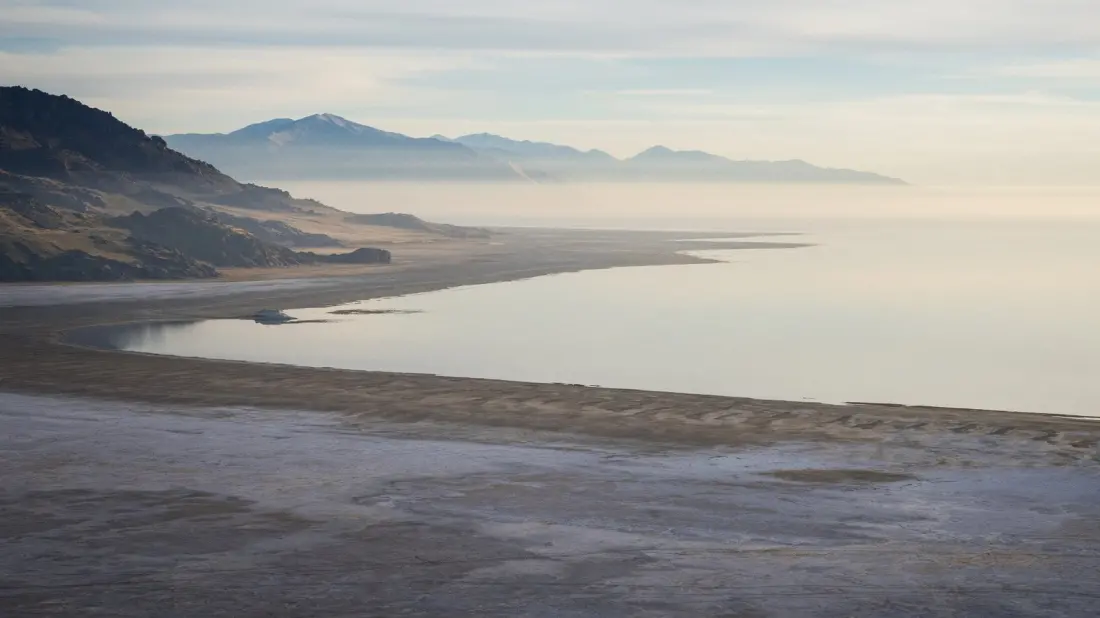
Utah's Great Salt Lake has earned an unflattering title: the dirtiest lake in the United States for swimming, according to a 2026 ranking by Lake.com. The site compared water data from the National Water Quality Monitoring Council across 100 of the country's largest lakes, and this huge saltwater body — less than an hour from Salt Lake City — came out on top, for all the wrong reasons.
The key metric is total dissolved solids, essentially the mineral load in the water: sulfates, chlorides, sodium, potassium and the like. The Great Salt Lake measured a staggering 134,500 mg/L, when anything over 1,000 mg/L is generally considered a red flag. There's also more ammonia here than in most other lakes sampled (0.92 mg/L), a byproduct of nearby mining, oil refineries and agriculture. The lake's geography doesn't help — it's terminal, with no rivers flowing out, so solids concentrate as water evaporates. Some of this is natural for a hypersaline lake, but the numbers still dwarf every other lake in the comparison.
Here's the twist: people still love the place. It's the largest saltwater lake in the western hemisphere, draws crowds who float effortlessly thanks to the extreme salt content, and generates roughly $1.3 billion a year for Utah's tourism economy. Sections like the Spiral Jetty and Stansbury Island even have strikingly pink water. Locals on Reddit describe a dip as surreal and a once-in-a-lifetime experience, and note that the salty residue rinses off easily — there are showers at Great Salt Lake State Park and the marina. Others suggest bringing your own water and bracing for a sulphurous smell in parts.
If the water quality report puts you off swimming, the lake still rewards a dry visit. Antelope Island State Park, on a large island in the southeast of the lake, is an International Dark Sky Park with solid mountain biking — try the 1.5-mile Elephant Head trail or the 11.7-mile Split Rock Loop, both with constant lake views. The Lady Finger Point trail near the visitor centre is an easy family hike along the shore. The island's biggest draw may be its free-ranging bison herds, some of the most reliable wild bison viewing outside Yellowstone; binoculars help on days the herd stays off the roads.
So who should go? Anyone curious about one of North America's strangest landscapes — the floating, the pink water, the bison against a mountain backdrop. Swimmers should go in with realistic expectations: the water is safe to float in but not to swallow, and you'll want that shower afterwards. For everyone else, it's a rare spot where the scenery justifies skipping the swim entirely.