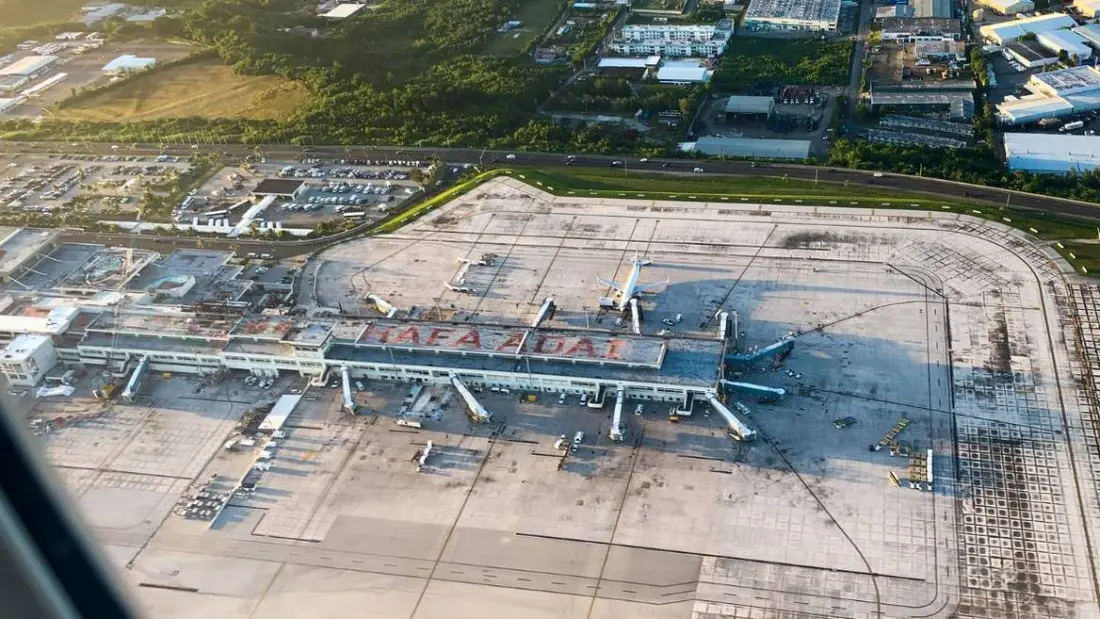
Guam sits about as far from Washington DC as American territory gets, yet Antonio B. Won Pat International Airport is fully US soil — complete with US immigration and customs. One recent traveller flying in from Yap, in the Federated States of Micronesia, learned the hard way: after previously travelling through countries like Iran, Iraq and Pakistan, he spent three full hours with Customs and Border Protection, including a baggage search and an hour of officers reviewing his phone chats. He called the officers professional throughout, but it's a fair warning for anyone with a complicated passport history arriving on this Pacific island.
The airport itself is a pleasant surprise. The terminal dates from 1998 but feels modern and clean, especially after hopping through small Micronesian airstrips. It's a hub for United Airlines, which runs roughly 87 weekly flights to 14 Asia-Pacific destinations — practically the entire domestic network is United flying Boeing 737s to Palau, the Federated States of Micronesia, the Marshall Islands, and the nearby Northern Marianas. Asian carriers including Korean Air, Japan Airlines, Philippine Airlines, Jin Air and Air Busan connect Guam to Japan (Tokyo twice, Nagoya, Osaka), South Korea (Seoul, Busan), Taipei and Manila. Honolulu is the only link to the wider United States.
For island-hoppers, Guam is the gateway. United's famous Island Hopper route threads through Chuuk, Pohnpei and Kosrae on its way to Honolulu — a 15-hour five-stop itinerary that recently cost about $1,170 one-way, barely more than the seven-hour direct flight ($1,163). Book early; this leg is popular and rarely cheap.
On the ground, things move at island pace — in a good way. Rental desks from Avis, Budget, Hertz, SIXT, Enterprise and others line the lower floor, and at least Economy Rent a Car runs 24/7. A $100 deposit got the writer a car picked up at 7:30 am and returned at 2:30 am with barely an inspection. The main gripe? WiFi. It failed at arrivals, worked in the food court, then died near the gates — so download offline maps before you land or grab a SIM if you're staying longer than a weekend.
The bigger picture is a hub in slow decline. Built for around three million annual passengers, Guam handled roughly 1.8 million in 2025, with aircraft movements halved from their 2019 peak. Japanese and South Korean visitors — the backbone of the tourism economy — fell from 1.7 million in 2019 to 783,000 in 2025, hammered by COVID's aftermath, Typhoon Mawar in 2023 and a weak yen. The resort strip near the airport is showing its age, and hotels vary widely in upkeep. For travellers, that cuts both ways: fewer crowds and competitive fares, but temper expectations about hotel polish and check recent reviews before booking.
Don't confuse the commercial airport with Andersen Air Force Base on the island's northern end, and note that nearly all mainland-style US chains and infrastructure mix with a distinctly Micronesian-Chamorro culture — about half the island's population has Micronesian roots. If you're piecing together Palau, Yap, Chuuk or the Marshalls, Guam is almost certainly your connecting point, and it handles the job well enough. — Simple Flying