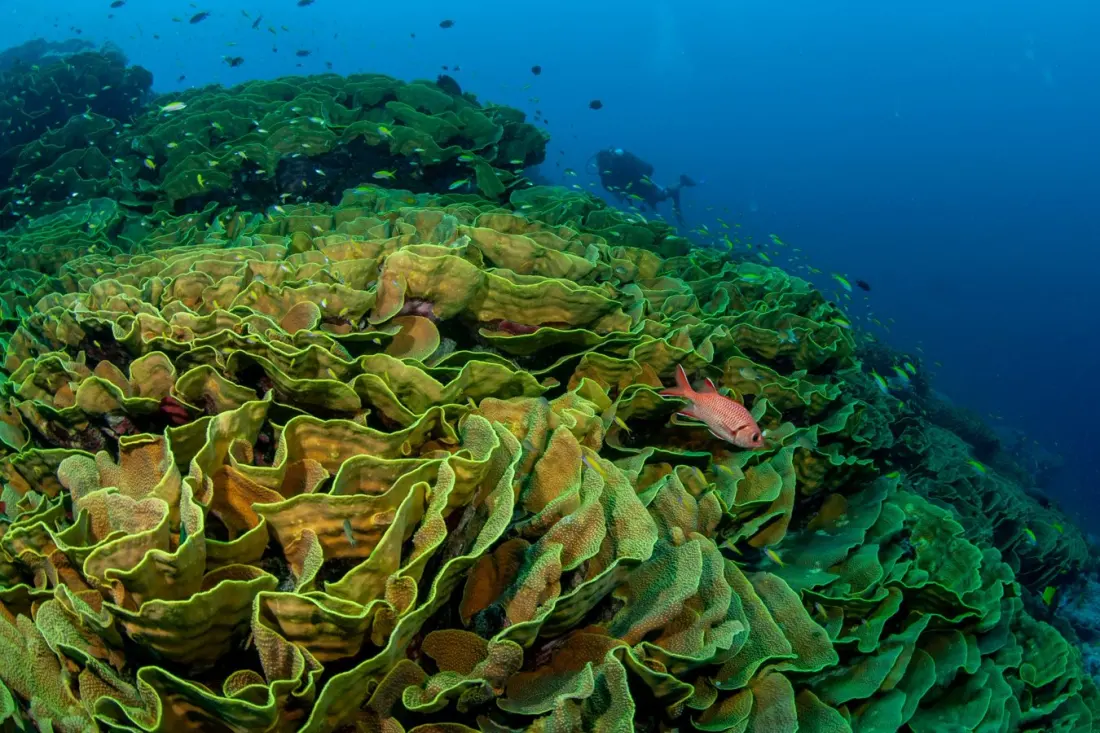
Divers off Australia's remote Cocos (Keeling) Islands have long known about the 'rose coral' on the outer reef. What nobody knew was how big it really is. Researchers from the University of Adelaide, Queensland Museum and James Cook University have now mapped it properly, and the numbers are startling: a single continuous Pachyseris formation covering roughly 56,940 square metres — about the footprint of the Sydney Opera House site — stretching 1.56km along the north-west outer reef slope at depths of 14 to 65 metres, averaging 36.5m wide. And there may be more: extra patches run another 200 to 300 metres beyond the mapped limits.
The mapping itself was a slow, manual slog. Lead researcher Dr Jean-Paul Hobbs first tried towing himself behind a boat, but curious sharks put a stop to that, so he swam the reef with a measuring tape instead. Running out of air before the coral ended, he marked his progress with GPS and came back with fresh tanks — twelve separate dives before he reached the end.
Local dive operator Dieter Gerhard spotted the first sections more than 30 years ago, but it was always unclear whether they were one organism or many neighbours. That question remains open. Corals can grow into vast formations either as one individual or via asexual fragmentation, where broken pieces settle and keep growing. Genetic testing of samples should settle it.
Why the coral grew so large is the other puzzle. Reefs are normally kept in check by storms, disease, predation and competition, and no single colony usually dominates. Professor Andrew Baird of James Cook University suggests conditions on this part of the reef have stayed unusually stable and favourable for a very long time — a rare natural experiment in what lets coral thrive.
For travellers, the discovery puts an already special destination in a new light. The Cocos (Keeling) Islands sit in the Indian Ocean, around 2,750km from Perth, and their isolation has produced coral communities found nowhere else — some species there may be new to science, according to Queensland Museum's Dr Tom Bridge. The reefs fall inside the Cocos (Keeling) Islands Marine Park, part of the Indian Ocean Territories Marine Parks created in 2022, so the habitat is protected. Divers with local operators have been exploring this outer reef for decades; the deeper slope where the rose coral lives is a serious dive, best suited to experienced divers, though the lagoons and shallower reefs are beginner-friendly.
If the thought of pristine reefs without crowds appeals, this is about as far off the beaten track as Australia gets — and clearly, there is still plenty left to discover there.