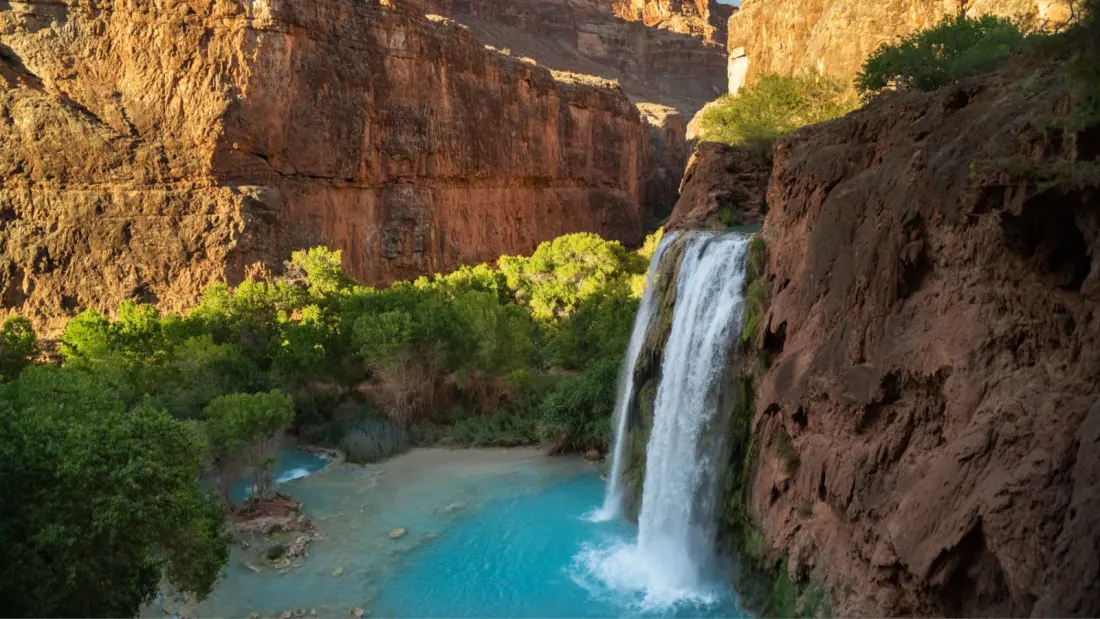
The impossibly blue waterfalls of Havasu Canyon are among the most photographed spots in the American Southwest — and yes, they really do look like that in person. But a writer for Backpacker who recently spent four days and three nights there came back with a different takeaway: the falls are the opening act, not the show.
Getting there is already a commitment. The trailhead at Hualapai Hilltop sits at the end of a long dirt road, and from there it's roughly 10 to 11 miles of hiking through a red sandstone canyon before you reach the campground — mostly downhill, but far more demanding than the Instagram posts suggest. Mule pack service exists, and a helicopter can shuttle you out, but you're still deep in the desert. Camping is first-come, first-served along Havasu Creek, and permits are the bottleneck: the Havasupai Tribe releases reservations each year on February 1 at 8 a.m. Arizona time, with a presale in late January. Late September through November is considered prime season.
The headline attractions cluster near camp: 90-foot Havasu Falls, 200-foot Mooney Falls — reached via slippery ladders and chains bolted into the cliff — and, three rough miles further, the pools of Beaver Falls. That's where most visitors turn around.
The author and his wife kept going, aiming for the Confluence, where Havasu Creek's electric-blue water meets the muddy Colorado River at the bottom of the Grand Canyon. Their navigation apps said six miles one way; a trail sign insisted otherwise, in capital letters. The apps were wrong. The real figure turned out to be over ten miles each way, on a trail that repeatedly enters the creek, scrambles over rock, and passes through a stretch of canyon so densely greened with vines and foliage it looks nothing like the desert around it. Past Beaver Falls, the crowds vanish almost entirely.
The payoff was equal parts surreal and delightful: five commercial raft trips moored at the canyon's narrowest point, and a river guide who handed them ice-cold beers from a cooler — more than 20 miles from the nearest paved road. The return leg brought the day to 22 miles with around 2,500 feet of elevation change, plus a standoff with a herd of bighorn sheep that had claimed the trail for dinner.
The lesson for anyone planning a trip: book the standard four-day, three-night permit and treat it as a real expedition, not a photo op. Budget a full day for the Confluence with plenty of water and heat planning — it's a serious desert hike. And if you only swim at the falls, you'll leave happy, but you'll have seen perhaps half of what this canyon offers. Few who visit ever make it past Mooney Falls, which means the greenest, quietest stretches of Havasu remain blissfully uncrowded for those willing to go further.