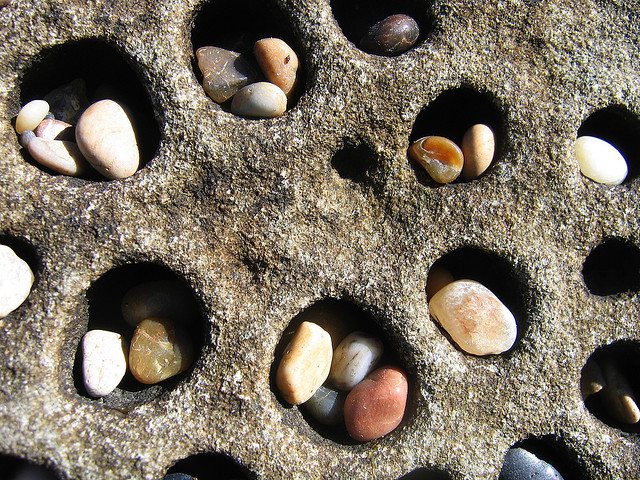
If you've ever wandered along a rocky shoreline and noticed clusters of small, pitted caves carved into the rock, you've already met tafoni — you just may not have known the name. These miniature caves form some of the most striking natural patterns in geology, and they turn up everywhere from tidal coasts to arid deserts, in almost every climate on Earth.
So what causes them? Interestingly, science still doesn't have a definitive answer. The leading explanation points to salt weathering combined with the rhythm of wetting and drying — salt crystals expand in the rock's pores and gradually break it down. Another theory involves cementation: as minerals carried by water precipitate and harden sediment into rock, the resulting structure is unevenly strong, so weaker patches erode away first, leaving hollows behind.
The timescales involved are surprising. The cementing itself can take millions of years, but once exposed, the rock can crumble back to grains within a single human lifetime. On coastlines, tafoni are thought to account for up to ten percent of coastal retreat — a quiet but significant force reshaping shores. Desert examples, by contrast, weather far more slowly.
Living things may play a role too. Some tafoni appear to begin with mollusks, sea urchins or clams, which bore tiny pits into rock to cling on and extract minerals. Once the creature dies, the hole is left exposed, and tides, wind and rain enlarge it over time into the familiar honeycomb shapes.
The name is as mysterious as the process. It may trace back to the Greek "taphos" (tomb), or to Sicilian and Corsican, where "tafoni" means windows and "tafonare" means to perforate. Geologists first formally defined the formations in the nineteenth century, dividing them into three types: honeycomb, cellular and nested.
And if they look a bit otherworldly, there's a reason. NASA's Pathfinder mission photographed tafoni-like structures on the surface of Mars — possibly evidence of ancient moisture on the red planet, or the work of some other erosion process entirely.
For travellers, tafoni are a free, always-on natural spectacle. Most people walk past them without a second glance, but once you know what to look for, entire cliff faces become sculptural galleries. They're particularly photogenic in low, raking light — early morning or late afternoon — when the shadows emphasise the depth of each cell. Coastlines with sandstone and granite are the best hunting grounds, and the formations vary dramatically in scale, from pits the size of a coin to caverns big enough to stand in.
A quick note of caution: heavily honeycombed rock is, by definition, rock that's actively crumbling. Admire it, photograph it, but avoid climbing on it or carving into it — some of these patterns are centuries in the making and fragile to the touch.
Whether you're a keen geologist or someone who simply likes unusual things to point at on a beach walk, tafoni reward a closer look. They're proof that some of the best travel sights don't require a ticket — just a slower pace and a curious eye.