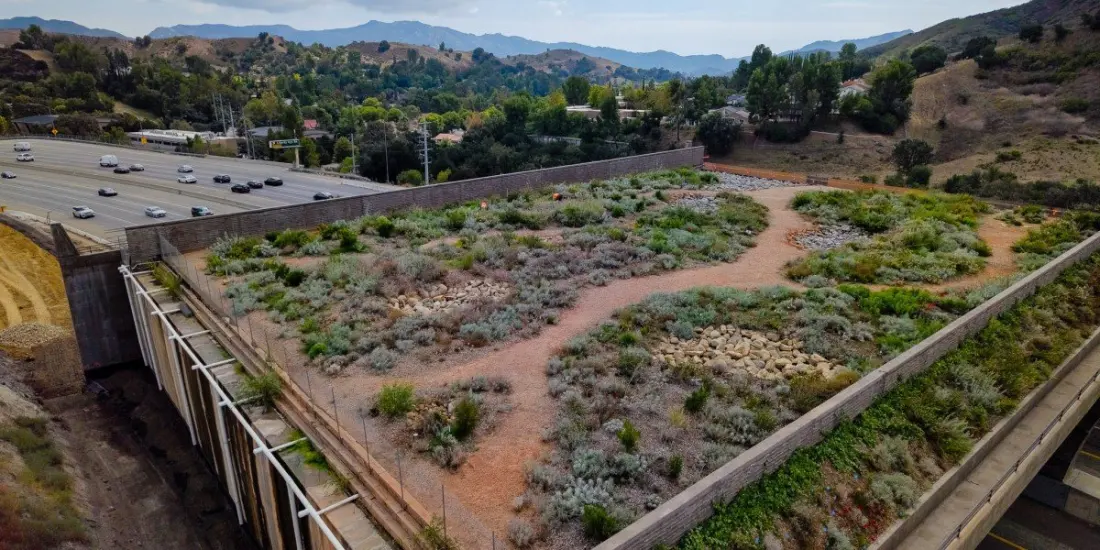
Over Agoura Hills' 101 Freeway, one of the most ambitious habitat projects in the US is taking shape — and its success is being decided years before it opens, in a nursery in nearby Calabasas. The Wallis Annenberg Wildlife Crossing, a 210-foot vegetated bridge set to open on December 2, 2026, aims to let mountain lions, bobcats and coyotes move safely between the Santa Monica Mountains and the Simi Hills, habitat fragmented by ten lanes of traffic since the freeway was built.
What makes this crossing unusual is how hyperlocal its planting is. In 2022, a seed collection team gathered roughly one million seeds from native plants growing within about five miles of the site, so the new landscape stays genetically true to the area. Those seeds now fuel a purpose-built nursery run jointly by the National Wildlife Federation, the Mountains Recreation and Conservation Authority and the Santa Monica Mountains Conservancy, where co-managers Jewlya Samaniego and Jose Campos raise plants for a project needing more than 50,000 specimens for its second phase alone — plus about 20 percent extra to cover losses.
Lead landscape architect Robert Rock of Rock Design Associates has designed the crossing around plant communities rather than individual specimens. The team mapped how species grow alongside each other in the wild — California buckwheat, black sage, toyon, laurel sumac and native grasses on the bridge itself, with coast live oak, valley oak, coffeeberry, chaparral yucca and arroyo willow in the wider habitat zones — and translated those relationships into modular planting plans contractors can follow. The site's grading even creates small sub-watersheds so moisture lingers where plants need it.
Just as notable is what's happening underground. The nursery propagates soil biology — native fungi, bacteria and microbes — alongside the plants, including mycorrhizal fungi matched to oaks. The crossing's soil was inoculated with microbes from the surrounding hills, and a native cover crop of Santa Barbara milk vetch, golden yarrow, California poppy and giant wild rye is jump-starting the nutrient cycle in place of conventional fertiliser.
There are small triumphs too. Desert wild grape, a native creekside vine that's increasingly hard to find, took roughly six dozen propagation attempts to crack. Planted dormant as bare twigs against a hot exterior wall, the vines are now among the crossing's thriving success stories.
Why should travellers care? Once open, the crossing will be visible from Liberty Canyon, and the surrounding Santa Monica Mountains already offer some of the best wildlife watching and hiking close to Los Angeles — a rare case of infrastructure designed for animals rather than people. Anyone driving the 101 through Agoura Hills can watch a genuinely historic restoration unfold. And for gardeners, the project's philosophy travels well: choose plants suited to your exact conditions, plant them in communities, and treat soil as a living system worth cultivating.