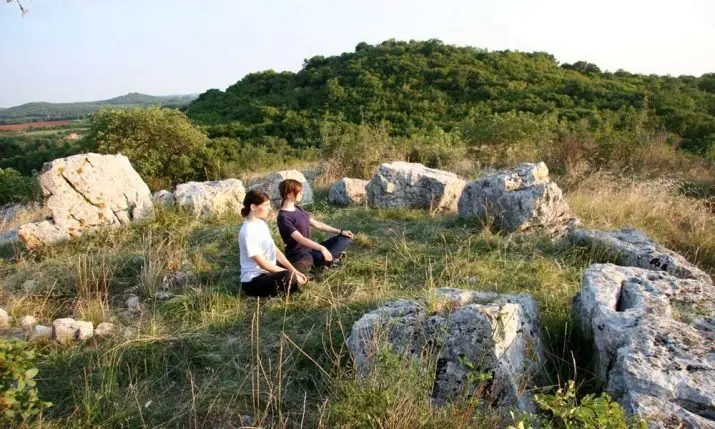
Croatia doesn't need to look to Wiltshire for its megalithic fix. On the hill of Mali Sveti Anđeo, a short distance from Poreč in Istria, sits a Bronze Age stone circle that locals and archaeologists have dubbed the Istrian Stonehenge — and after more than 3,000 years, nobody is quite sure why it's there.
Dating work places the structure in the Middle Bronze Age, roughly between 1600 and 1300 BC, built by the people who then lived in Istria — whose ethnic identity, intriguingly, remains unknown. Davor Munda, an archaeologist at the Poreč Regional Museum, is among those studying the site. Excavations in the 1960s turned up a small ceramic vessel, a flint blade fragment and plenty of goat and sheep bones, which has fuelled the idea that rituals took place here.
The more tantalising theory is astronomical. Astronomer Korado Korlević suspects the circle functioned as a calendar, possibly used to track the Sun's movements — a reading partly inspired by the entrance being positioned on the northern side of the structure. He has built a reconstruction as a stage for Astrofest but argues the site deserves fresh excavation to settle the question. Both the stones' original arrangement and their purpose are still open problems: some stones have tumbled down the hillside over the centuries, and today mostly just the foundations survive.
The monument has also drawn a less scientific crowd. Film director and musician Mladen Đaković is among those who claim the area is a crossing point for so-called dragon lines — imagined energy channels through the Earth. Archaeologists would politely point out there's no evidence for that, but the theories say something about the site's pull on the imagination.
For travellers, the practical upside is that this isn't a lonely curiosity. The surrounding landscape holds several other prehistoric sites — Mordele, Veliki Sveti Anđeo and Picugi — so a half-day of hill walking around Poreč can string together a genuinely ancient itinerary that most visitors never see. And if you want to see the circle as its builders might have, a full-scale reconstruction stands at the Tičan Observatory, where it stars in the annual Astrofest celebrations each June.
Poreč itself makes an easy base: a coastal town with Roman-era streets, and within reach of hill villages, vineyards and truffle country further inland. Add the Istrian Stonehenge to the list and you get a reminder that this peninsula's history runs far deeper than its postcard towns suggest. Whether it was a temple, a calendar or something else entirely, no one can yet say — which is arguably part of the appeal.
Story via Croatia Week.