
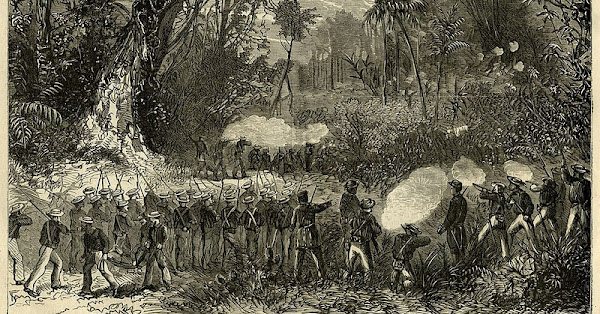
The southern tip of Taiwan is best known today for Kenting's beaches and the lighthouse at Cape Eluanbi, the island's southernmost point. But in June 1867, this same coastline hosted one of the US military's first interventions in East Asia — and one of its most embarrassing.
The trouble began that March, when the American merchant ship Rover wrecked on an uncharted reef off Cape Eluanbi. Around two dozen crew and passengers made it ashore, only to be killed by the indigenous Paiwan people. A lone Chinese sailor survived to tell the tale. When Washington demanded action, Qing officials — whose control over Taiwan's rugged indigenous territories was nominal at best — effectively told the Americans to handle it themselves.
So in early June, Rear Admiral Henry H. Bell sailed from Shanghai with the warships USS Hartford and USS Wyoming, carrying roughly 180 sailors and Marines. They landed near the island's southern tip on June 13 with a simple mission: find the village responsible and punish it. Simple, it turned out, was the wrong word.
Southern Taiwan in 1867 was dense forest, bamboo thicket, ravines and steep ridges. The Paiwan fighters knew every trail and observation point, wore face paint to blend into the greenery, and fought by ambush — firing from cover, melting away, then reappearing elsewhere. The Americans had superior firepower but no accurate maps, little intelligence, and heavy uniforms in oppressive heat. After six hours of jungle marching, they had achieved nothing, suffered heat exhaustion, and lost Lieutenant Commander Alexander Slidell MacKenzie, the campaign's only confirmed casualty on either side. The force withdrew to its ships.
The aftermath is arguably more interesting than the battle. American consul Charles W. Le Gendre negotiated directly with Paiwan chiefs, who pledged to protect future shipwreck survivors — an agreement that didn't fully hold, as the 1871 killing of dozens of shipwrecked Ryukyu sailors showed. That incident prompted Japan's 1874 invasion of southern Taiwan, its first major overseas military operation, which succeeded militarily but cost over 500 men to disease.
For today's traveller, the story is a reminder that Kenting's resort strip sits on layered history. Cape Eluanbi's lighthouse, built later in the 19th century partly to aid shipwrecked mariners, is a direct product of this bloody era. Museums in Hengchun, the old walled town nearby, cover the region's indigenous Paiwan culture, which remains very much alive — you can visit Paiwan communities in Pingtung County and see their distinctive art, including the carved motifs and face-tattoo traditions referenced in accounts like this one.
Why care? Because knowing this history turns a beach holiday into something richer. The cliffs and forests where Marines floundered in 1867 are now hiking trails in Kenting National Park, where butterfly-watching and coastal walks have replaced gunboat diplomacy. It's also an early, small-scale preview of a pattern that would echo through the 20th century: modern firepower meeting defenders who know the terrain. A one-day raid, fewer than 200 men — and a lesson decades ahead of its time.
Story sourced from Amusing Planet.