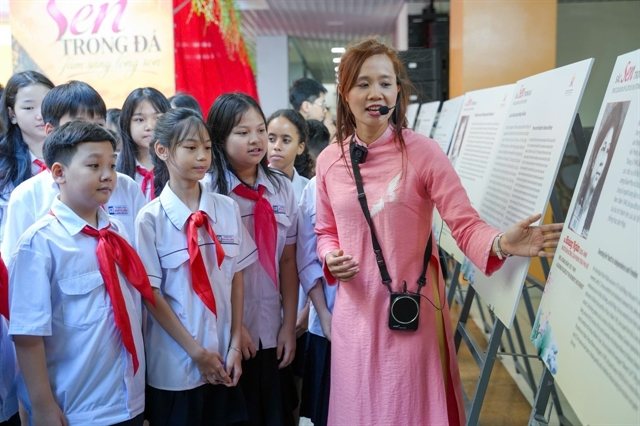
A small photo exhibition on Hanoi's Hàm Long Street is doing something most history displays don't: filling with schoolchildren. Lotus in Stone: True Heart, Pure Soul, staged by the Vietnamese Women's Museum with the Cửa Nam Ward People's Committee and the Việt Nam Cultural Heritage Association, opened on October 6 and ran until October 8, timed to the 72nd anniversary of Hanoi's liberation.
The show profiles 25 female political prisoners from Vietnam's resistance wars against the French and Americans. The names are heavyweights in Vietnamese history: Nguyễn Thị Minh Khai, Nguyễn Thị Định, Hoàng Ngân, Nguyễn Thị Bình, Võ Thị Sáu and Trương Mỹ Hoa, the former vice president who appeared at the opening. The lotus of the title — Vietnam's national flower, which rises clean out of muddy water — stands in for women who endured prison and loss yet refused to break. Trương Mỹ Hoa put it plainly at the event: today's "stone" is no longer a prison wall but everyday hardship, and anyone who perseveres can be a lotus of a new era.
This Hanoi edition follows a larger Lotus in Stone exhibition at the Côn Đảo Museum in Bà Rịa Vũng Tàu Province in May — worth knowing, because Côn Đảo is where many of these women were actually imprisoned, and the island's former prison complex is now a sobering historical site you can visit.
What made the Hanoi show different was the format. Alongside the portraits, students from Ngô Sỹ Liên Secondary School performed music, dance and short plays recreating episodes from the women's lives — history delivered as theatre rather than textbook. The school's principal, Phạm Thu Hà, described it as a meeting between young Vietnamese and women who gave up ordinary dreams of family and home when the country called.
For travellers in Hanoi, the takeaway is less about this three-day pop-up than about the museum behind it. The Vietnamese Women's Museum, on Lý Thường Kiệt street in the Hai Bà Trưng district, is one of the city's most rewarding stops and regularly mounts exhibitions like this on women's roles in war, family life and ethnic minority cultures. It's a window into a side of Vietnamese history that standard war-museum itineraries often skip, and it's an easy walk from the Old Quarter. If your trip happens to coincide with early October, look out for anniversary programming around Hanoi's liberation day (October 10), when the city tends to lean into exactly this kind of historical storytelling.