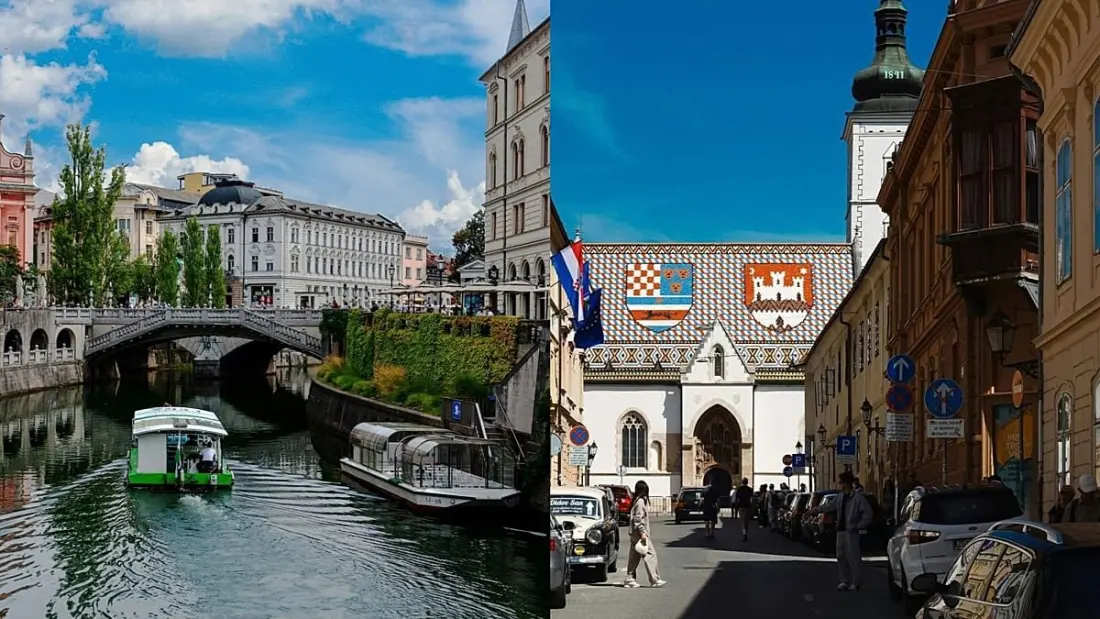
Slovenia and Croatia both get plenty of love from holidaymakers – but usually for Lake Bled or the Adriatic coast. Their capitals, meanwhile, stay oddly quiet. That's good news if you like a European city break without the crowds, because Ljubljana and Zagreb each pack a lot into a small, walkable centre. And if you genuinely can't choose, they're only two and a half hours apart by train or bus, so a double-header is entirely doable.
Ljubljana has been car-free in the centre since 2007, which makes aimless wandering – arguably the whole point of a city break – genuinely pleasant. Start at the Triple Bridge over the Ljubljanica River, part of a UNESCO listing covering the work of architect Jože Plečnik, who shaped much of the city between the wars. His legacy shows up all over town: the National and University Library, the open-air Križanke theatre, and Plečnik House, where you can see his original furniture and tools.
Food-wise, Trubarjeva Street is the go-to strip of independent cafés and restaurants, and from March to October a Friday visit lines up with the Open Kitchen market near the Central Market. The hilltop Ljubljana Castle, first built in the 11th century with much of today's structure dating from the 1500s, is reached by funicular and offers a viewing tower plus wine grown on the castle slopes. After dark, Metelkova Mesto – a squatted former military barracks turned cultural centre since the 90s – hosts art spaces and club nights.
Zagreb, across the border, rewards a slower pace. The Upper Town concentrates the historic sights: the 13th-century Stone Gate, home to a shrine to Mary that famously survived an 18th-century fire and made her the city's patron. St. Mark's Church is the colourful star, its tiled roof displaying the Zagreb emblem and historic Croatian coats of arms. Time your walk for noon to catch the Grič cannon fired from Lotrščak Tower, a daily ritual since 1877.
For something lighter, the Museum of Broken Relationships collects donated breakup objects from around the world – including a 'toaster of vindication' – and has proved popular enough to open a second location in Thailand. Note that Zagreb Cathedral is still under restoration after the 2020 earthquake. Below the Upper Town, the 19th-century Lower Town offers the Green Horseshoe park system, the Botanical Garden, several major museums, and plenty of bars and cafés around Ban Jelačić Square.
So which one? Ljubljana suits travellers who want a compact, green, car-free centre with a quirky nightlife edge; Zagreb offers more layered history, museums and Austro-Hungarian grandeur, often at lower prices and without tour groups. Either way, both are easy weekend-scale trips that deserve more attention than they get.
Credit: Euronews Travel