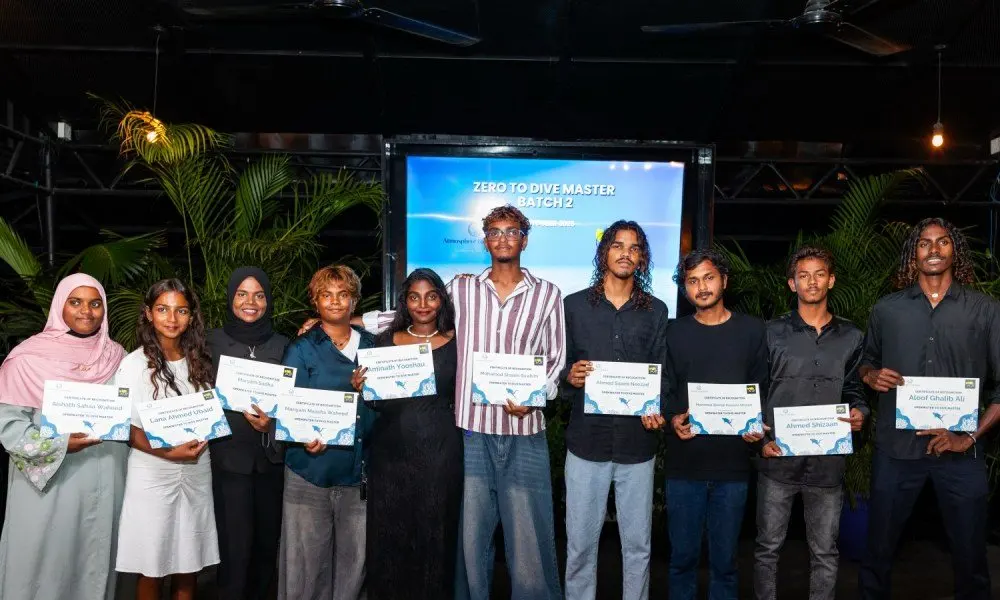
Twenty young Maldivians have now gone from never having dived to holding professional Divemaster certifications, thanks to the Zero to Hero-style scholarship run by Atmosphere Foundation. The second cohort of ten graduated recently, and the numbers from the first intake explain why the programme is being extended.
The first batch, which started in April 2026, saw all ten participants earn their professional Divemaster qualification. Nine of them have since found jobs on safari boats, at resorts and in island-based dive centres — a 90 per cent employment rate, and one that keeps climbing: only three had work when the second batch launched in July, with the figure reaching nine as resorts and operators came calling.
The training itself is a structured three-month ladder run with Moodhu Bulhaa Dive Centre in Vilimalé. Students progress from PADI Open Water through Advanced Open Water, Emergency First Response and Rescue Diver before finishing at Divemaster level. Alongside the diving, there's coaching in safety, emergency response and what the job actually demands of you professionally.
What makes the scheme genuinely accessible is the money side. Atmosphere Foundation covers tuition, certification and registration fees, plus accommodation and meals for the duration. The second batch's scholarship also paid for training materials and dive insurance, removing most of the financial barriers that keep locals out of professional diving. The catch — a reasonable one — is a two-year commitment to work in the Maldivian diving and marine industry after qualifying, so the skills stay in the country.
It matters because diving underpins a huge slice of Maldivian tourism, and resorts, liveaboards and local dive centres all need qualified staff. The foundation has confirmed the programme will continue with further intakes, so this looks less like a one-off training course and more like a functioning employment pipeline.
Elsewhere in the Maldives, the source rounds up a few recent stories worth knowing about. Seven sea turtle hatchlings made their scramble to the sea at Cinnamon Velifushi in Vaavu Atoll — a reminder that turtles nest across nearly all the country's atolls year-round, mostly green turtles, with eggs hatching after roughly two months. Hatchlings are easily disoriented by artificial beach lighting, so resorts' dark-beach policies genuinely matter.
Pullman Maldives Maamutaa has added six Indo-Pacific leopard sharks to the national MIYARU identification database, each named and recognisable by its unique spot pattern — think fingerprinting, but for sharks. The house-reef documentation was led by in-house marine biologist Kayla Shortt, and guests can often spot these sharks themselves on reef snorkels and dives.
And Siyam World is leaning hard into fantasy for the festive season with its 'Age of Legends' programme from 15 December: ex-Manchester United captain Nemanja Vidić runs a football camp from 18 December, former AC Milan striker Alessandro Matri follows from 25–27 December, and a musical based on the classic Maldivian legend Dhonhiyala and Alifulhu takes the stage on 21 December.
For travellers, the through-line is clear: the Maldives' underwater world is being taken increasingly seriously, both as a workplace for locals and as something resorts actively protect and showcase. Divers choosing where to stay may find that conservation output — turtle beaches, shark databases, trained local divemasters — is a decent proxy for the quality of the dive operation on site.