Some mountains are just peaks. Mount Nimba, straddling the borders of Guinea, Liberia and Côte d'Ivoire, is more like three or four different ecosystems stacked on top of each other — and that stacking is exactly what makes it one of West Africa's most important natural sites.
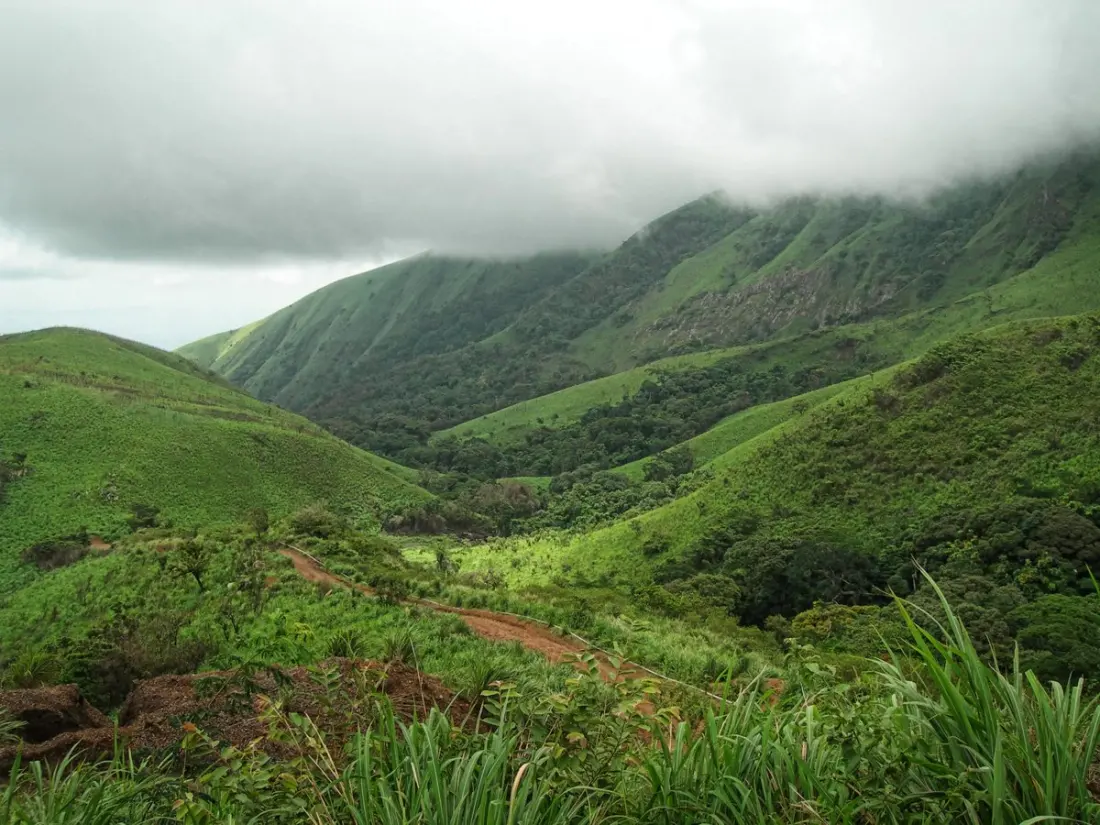
The mountain rises to about 1,752 metres, high enough that climbing its slopes means moving through dense tropical forest at the base, montane forest in the middle, and open mountain grasslands near the top. Each band of altitude brings different soils, temperatures and plants. Botanists have recorded more than 2,000 species of vascular plants in the reserve, several of them found nowhere else.
The animals are the real headline act. The Mount Nimba viviparous toad skips the tadpole stage entirely and gives birth to fully formed young — a quirk almost unique among frogs and toads, and one reason it's so vulnerable: it lives only in a narrow high-altitude zone. Then there's the otter shrew, a small semi-aquatic insectivore tied to the mountain's streams. And the reserve's West African chimpanzees have been observed using stones as tools, behaviour that has made them famous among primatologists.
Water is another reason Nimba matters. Often described as a natural water tower, its springs and slopes feed waterways that sustain ecosystems and communities far beyond the reserve's boundaries. The forests also regulate local climate conditions, so damage here ripples outward.
That's the worry. The mountain sits on valuable iron ore, and mining pressure, agricultural clearance, hunting and escaped fires are all gnawing at the wider landscape. The Mount Nimba Strict Nature Reserve was inscribed as a UNESCO World Heritage Site in 1981, but it has sat on the List of World Heritage in Danger since 1992. Because the protected area spans Guinea and Côte d'Ivoire while the range extends into Liberia, conservation depends on cooperation across three national borders — plus patrols, monitoring and buy-in from local communities who rely on the mountain for water, food and medicinal plants.
Why should a traveller care? For anyone drawn to genuinely remote, ecologically significant places — think hardcore birders, primate enthusiasts and hikers who like their trails empty — Nimba is one of Africa's least-visited natural wonders. Access is challenging and tourism infrastructure is minimal, which is precisely its appeal, and precisely why low-impact, well-guided visits matter: money from responsible travel is one of the few arguments against the bulldozers. It's a place to see now, carefully, before the pressures change it for good.
Story via Getaway South Africa.