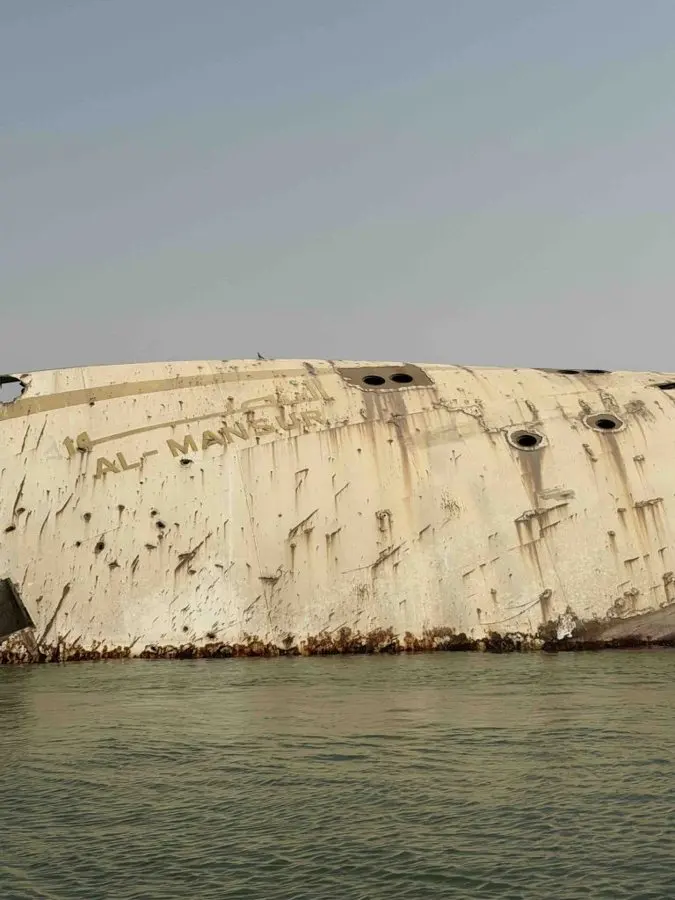
Floating down the Shatt al-Arab river in Basra, you'll spot a rusting hulk listing on its side in the shallow mud. That's the Al Mansur — once Saddam Hussein's flagship superyacht, now one of the strangest sights in Iraq and an accidental monument to the country's turbulent recent past.
The Al Mansur was ordered in 1983 and built in Finland, a 7,500-tonne, 121-metre vessel reportedly bankrolled as a gift from the Saudi royal family. Danish designers filled it with 1980s excess: a glass-domed atrium, a grand banquet hall, marble everywhere and gold trim. It could host 200 guests served by a crew of 60. But it was also built like a floating bunker — thick steel decks, bulletproof glass, a naval hospital with an operating theatre, a helipad, and a secret escape route from the presidential suite down to a mini-submarine pod. The strangest detail of all? Saddam, consumed by security fears, never actually set foot on board. He also owned two smaller yachts, the 82-metre Basra Breeze and the 67-metre Al-Qadisiya, plus more than 100 palaces across Iraq and the Kurdistan region — including one looming over the ruins of Babylon that you can still visit, its walls covered in soldier graffiti.
The Al Mansur's end came during the 2003 invasion. Moved to Basra to hide it from airstrikes, it was targeted anyway after intelligence suggested its sophisticated radio suite was being used for Iraqi military communications. Over three days, US Navy S-3B Vikings and F-14 Tomcats hit it with laser-guided Maverick missiles and 500-pound bombs, burning out the interior. The yacht capsized and sank in the river, and looters stripped it of marble, panelling, electronics and scrap metal. With no salvage operation ever funded, the hulk has simply stayed put for two decades.
Today it's an odd local landmark — fishermen cast lines from it, photographers gather, and curious visitors add it to an Iraq itinerary that already punches absurdly hard: Babylon, Ur, Hatra, the holy cities, the souks of Baghdad, and Newroz celebrations in Kurdistan. A wrecked dictator's toy sitting in a working river isn't a polished attraction, and that's precisely the appeal for travellers drawn to places where history hasn't been tidied up. Iraq is opening up to tourism, and sights like this — alongside Saddam's looted Babylon palace — tell the story of the dictatorship and its fall better than any museum.
Basra itself is worth more than a stopover: it's Iraq's only major port city, sitting on the Shatt al-Arab where the Tigris and Euphrates meet the Gulf, with a growing reputation for friendly hospitality and a frontier-town energy you won't find in Baghdad or Erbil. Pair the yacht with the nearby Babylon palace and you get a two-site course in how the other half of Saddam's Iraq lived — and how abruptly it all ended.