Okinawa's capital often gets treated as a gateway — land at Naha, hop onward to the beaches, done. That's a mistake. This city of roughly 300,000 has its own personality, shaped by centuries as the seat of the Ryukyu Kingdom and its spot between Japan, China, Korea and Southeast Asia. The kingdom, founded in 1429, ran a busy trade network during its 14th-to-16th-century "Great Trading Age," and those foreign influences — plus a dash of Americana from the U.S. military era that ended in 1972 — still flavour everything from the food to the architecture.
Start with Shuri Castle, the former royal seat and a UNESCO World Heritage Site. It's been destroyed and rebuilt repeatedly: levelled in the 1945 Battle of Okinawa, restored by 1992, then gutted by fire in 2019. The main hall finally reopens on November 23, 2026, after seven years of restoration work. Nearby, you can also visit Tama-udun, a limestone royal mausoleum with Chinese-style motifs, and Shikinaen Garden with its circular paths and stone bridges. For a different architectural note, Fukushuen Garden showcases Naha's Chinese connections with pavilions, ponds and twin pagodas.
Food is where Naha really diverges from mainland Japan. The signature dish is champuru — literally "blend" — a stir-fry of tofu, egg and bitter melon with pork or Spam, the tinned meat that arrived with American troops and stayed. Add thick wheat-noodle Okinawa soba, taco rice (exactly what it sounds like) and sata andagi donut holes, plus Blue Seal ice cream in flavours like sweet potato and Okinawan salt cookie. The best place to taste it all is Makishi Public Market: shop the ground-floor stalls, then take your purchases upstairs where restaurants will cook them for you on the spot for a small fee — a custom called mochiage.
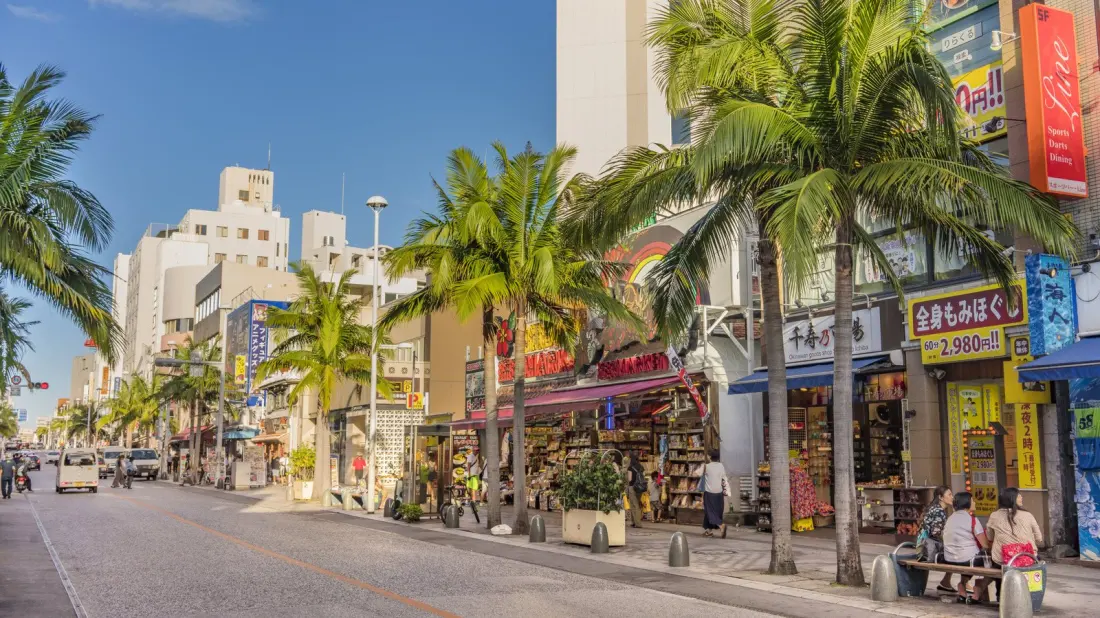
Shopping follows on Kokusai-dori, the nearly mile-long downtown strip lined with boutiques, souvenir shops and eateries. It's at its best on weekends — buskers perform Saturday nights, and on Sundays from noon to 6pm the street goes car-free. The Heiwa-dori Arcade nearby skews more local. Potters should detour to Tsuboya, Naha's ceramics district since the 1600s, to hunt for shisa guardian lion figurines and glazed tableware.
Time your trip for spring or late autumn, when the weather is pleasant and typhoon risk is low, and you might catch a festival: the Naha Hari dragon boat races in May, October's Tug-of-War Festival with its giant straw rope, or November's Shurijo Castle Festival parade in Ryukyu-era costume along Kokusai-dori. And when you do want the beach, a 50-minute ferry from Tomari Wharf gets you to Zamami Island and its famously blue water.
Getting in is simple — flights from mainland Japan and abroad land at Naha International Airport (OKA), with the monorail or a car downtown in under 20 minutes. Give the city two or three days before chasing the outer islands; it earns them.