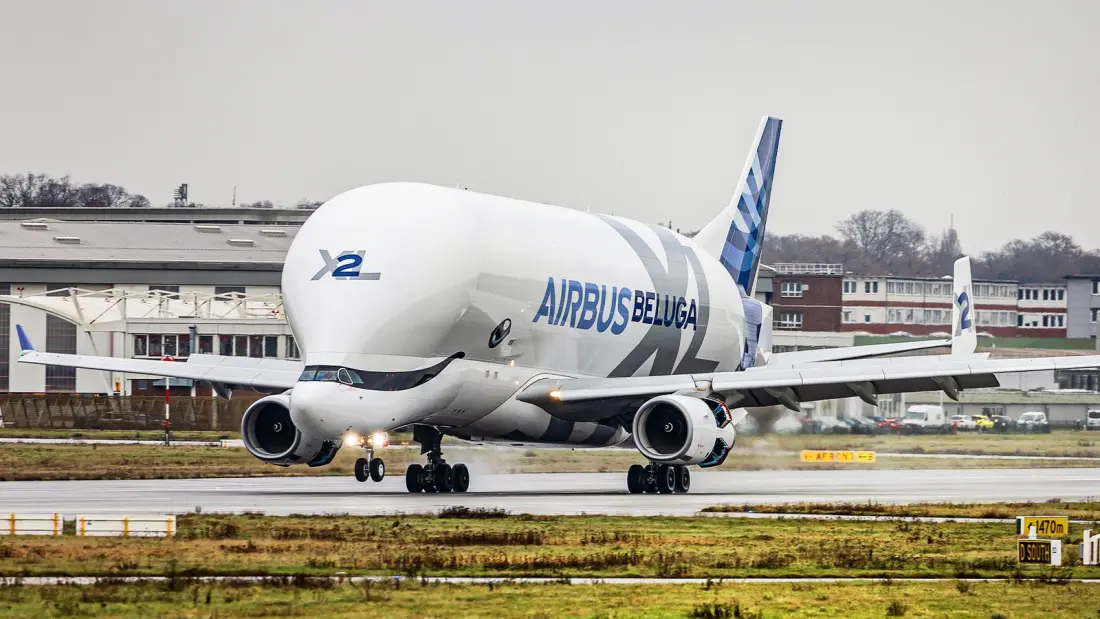
Airbus' Beluga XL looks like a whale, and it works like one too — swimming back and forth across Europe rather than crossing oceans. A week of tracking data for F-GXLH, one of the manufacturer's A330-700 Beluga XL freighters, shows exactly how this odd-looking aircraft earns its keep: 15 flights, more than 28 hours airborne and roughly 10,193 miles logged in just seven days, all on short hops between factories.
The week in question — November 11 to 17 — took F-GXLH to five airports across France, Germany and the UK. Toulouse-Blagnac, home of Airbus' headquarters and main assembly lines, was the clear anchor with 12 arrivals and departures. Hamburg-Finkenwerder, the German production site, saw eight movements, and the Toulouse-Hamburg pairing alone accounted for five of the week's 15 flights. Hawarden in Wales, the airport serving Airbus' Broughton wing-making plant, recorded six movements, while Bremen and Saint-Nazaire Montoir handled two each.
The rhythm of the schedule is striking. Wednesday, Saturday and Monday were all three-flight days. Monday was the heaviest by air time: a two-hour-17-minute run to Hamburg — the week's longest leg — followed by a hop to Saint-Nazaire and a 49-minute dash back to Toulouse, the shortest. The only day off was Sunday. There were no long layovers anywhere; the pattern is a steady shuttle service, with the aircraft almost always back in Toulouse by nightfall.
F-GXLH wasn't alone. Sister ship F-GXLN matched its 15 flights but spent just 21 hours in the air, while F-GXLG flew 13 times and F-GXLI 11 times. Even the older A300-600ST Beluga put in six flights. Across eight tracked aircraft, the fleet combined for around 70 flights and roughly 96.5 hours of flying in a single week — a quiet but constant logistics operation that keeps Airbus' dispersed European factories supplied with oversized parts like wings and fuselage sections.
Why does this matter to travellers? Partly because the Beluga's route map doubles as a guide to Europe's aviation heartland: Toulouse, Hamburg, Bremen and Hawarden are all working aerospace cities with strong aviation culture. Toulouse in particular has become a genuine holiday draw — you can often watch Belugas arrive and depart near the airports, and the city's Aeroscopia and Airbus-focused museum offerings make it a dream stop for plane spotters. Hawarden, near Chester, similarly offers rare close-up views of these peculiar aircraft for anyone who times a visit well. The story is also a reminder that some of aviation's most interesting movements happen not on long-haul routes but on unglamorous afternoon shuttles between industrial airports — and unlike scheduled passenger flights, they can be spotted and tracked by anyone with a flight-tracking app.