Skip the queue at the Eiffel Tower and head uphill instead. Belleville, straddling the 19th and 20th arrondissements in Paris's north-east, is the district where writers, market shoppers and café regulars get on with real Parisian life — and where visitors are quietly welcomed into it.
Start on Boulevard de Belleville on a market morning. Stalls stretch down the long boulevard under sophora trees, piled with Mirabelle plums, glossy tomatoes and wheels of Brillat-Savarin, while locals haul the striped shopping trolleys that are practically a uniform here. It's loud, sociable and utterly unpolished — the opposite of the museum-queue version of the city.
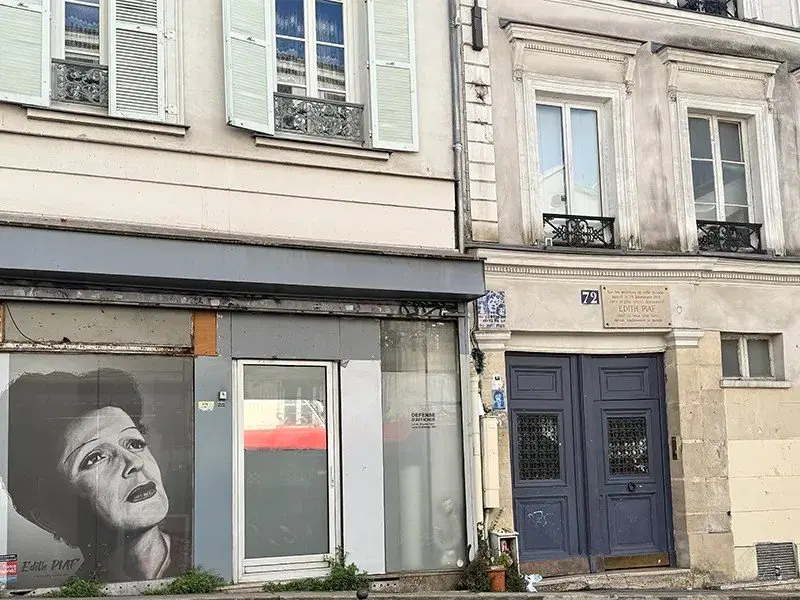
A few steps away on rue de Belleville sits Aux Folies, a bar that has watched over the street since the early 20th century. It began life serving theatre-goers, spent time as a hairdresser's salon (hence the hall of mirrors), and picked up its neon-and-mosaic interior in the 1950s. Staff there recount how metro vibrations weakened its foundations so badly that specialists had to shore the building up. Édith Piaf is said to have sung here; a plaque at number 72 rue de Belleville claims she was born on the steps on 19 December 1915.
Belleville's identity has always been shaped by arrivals. Auvergnat coal sellers became wine sellers, then opened Paris's first cafés — Le Mistral at the corner of rue des Pyrenées still serves saucisse-aligot, the sausage-and-cheesy-mashed-potato dish from their home region. More recent waves brought Thai kitchens like Ama Siam, North African spice shops such as Epicerie La Caire, and the general store Bazar de Belleville.
The bonus: this is one of the best free view districts in Paris. From the streets climbing the hill, the Eiffel Tower appears framed between mismatched rooftops and graffiti. Parc de Belleville and the larger Parc des Buttes Chaumont both offer lookouts, while the corner of rue des Envierges and rue Piat has a cluster of painted restaurants — Mon Coeur Belleville and vegan spot Les Bols d'Antoine among them — above a small craft market at the Belvedere.
For lunch, locals point to Bar Fleuri on rue du Plateau for its poulet-frites, then to the village-like Rue des Cascades and the mosaic-fronted former fish shop on Rue de la Mare for a slow wander. Writer Chris Newens, who lives nearby and wrote Moveable Feasts about the signature dish of each arrondissement, puts it simply: Paris's big monuments are things you look at, but the outer districts are where you actually experience the city — book in hand, coffee on the terrace.
Belleville suits anyone on a second or third Paris trip, travellers who'd rather eat where residents eat than tick off landmarks, and anyone hunting street art, cheap and excellent food, and skyline views without the crowds. Metro lines 2 and 11 get you there in minutes from central Paris.