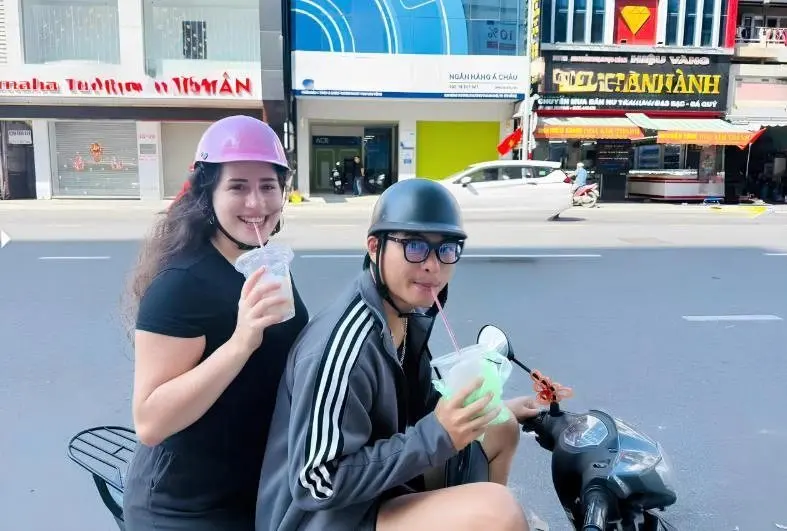
Karin Di Paola, a 21-year-old from Italy's Veneto region, arrived in Ha Giang in April 2025 with a tight itinerary: one night at a homestay, then off to ride the famous Ha Giang Loop. Instead, she never rode it that week — and never really left.
Her homestay, about 5 km from Ha Giang city, was run by Lục Thế Khải, a 26-year-old from the Giáy ethnic community who had recently returned from Hanoi to start a business at home. Their first meeting was a comedy of miscommunication: she asked how far the city centre was, his English failed him, and after 15 seconds he simply held up five fingers. They got by on a translation app, and that evening he took her out for bánh cuốn, the steamed rice rolls northern Vietnam does so well.
The next day Karin fell ill with severe stomach pain and cancelled her Loop plans. Khải, worried his dinner had caused it, stayed close, brought her food and looked after her until she recovered, then took her around Ha Giang himself to make up for the ride she missed. Feelings followed fast.
The deciding moment came a week later. Karin headed to Cao Bang alone after Khải turned down her invitation — and immediately regretted it. After five days apart, she messaged him: should she come back? His answer was that his heart had already decided. She returned, and this time she stayed.
Nearly a year on, the couple live together in Ha Giang, building up the family homestay, making online content about their Italian-Vietnamese life, and saving for a wedding. Both families are on board: Karin's mother Daniela, who had volunteered in Vietnam in the 1990s and first put the country on her daughter's radar, visited in June with her husband and came home already planning a return trip.
The cultural adjustment took some work. Karin says Italians say affection out loud, while Vietnamese partners often express it through practical care — something she came to understand properly when Khải supported her through a family bereavement earlier this year, tending to her much as he had during that first illness.
Why should a traveller care? Because it's a lovely reminder of what slow travel can do. The Ha Giang Loop is usually sold as a box to tick — three or four days on a motorbike, photos of the karst peaks, onward bus. But the province's homestays are run by real people, many from ethnic minority communities like the Giáy, Nùng and Hmong, and a few extra days in one place can turn a route into a relationship with a destination. Karin's story is unusual, sure, but the hospitality that started it isn't. Book the homestay, skip the rush, order the bánh cuốn. You never know.