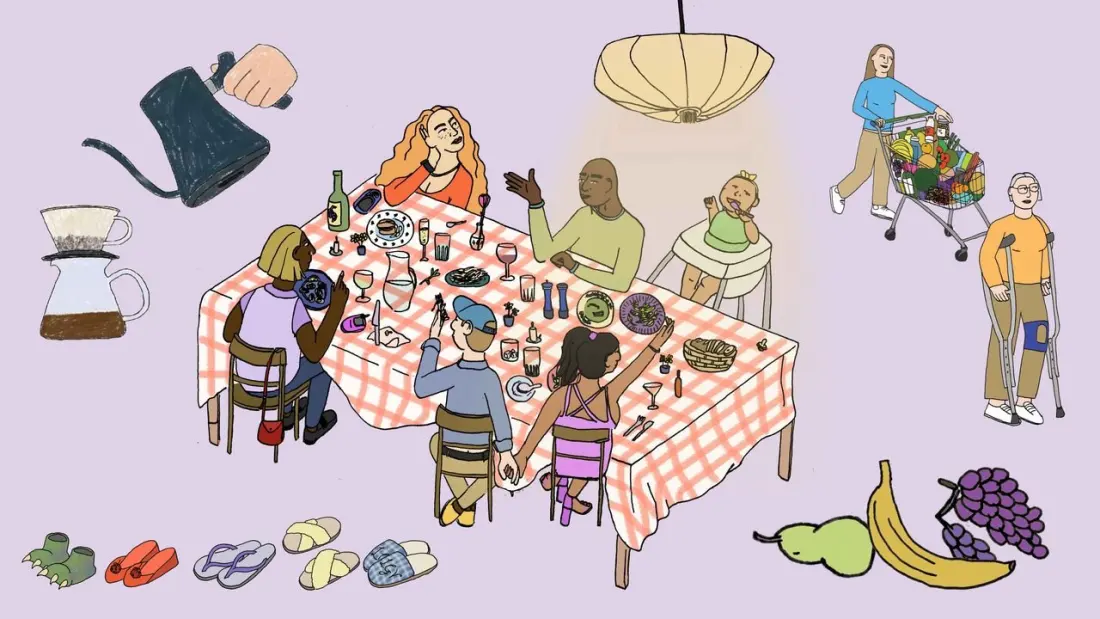
A framed feature in Condé Nast Traveler, illustrated by writer and artist Mona Chalabi, rounds up family travel advice from writers, photographers and food editors — people who move around constantly and have figured out where the money actually leaks on a trip with kids. The recurring theme: skip the expensive, ticketed version of a holiday and let the ordinary stuff do the work.
Food comes up again and again. Food director Chris Morocco travels with his own coffee kit — hand grinder, pour-over, yesterday's pastry — so his teenagers' late mornings don't drag everyone into a costly sit-down breakfast. CNT video chief Dana Kravis treats snacks as entertainment, mood management and cultural education rolled into one, restocking a lightweight backpack each morning with fruit from a local market or even a Tokyo 7-Eleven. And writer Christine Chitnis makes a counterintuitive case from Rajasthan: her family's worst food poisoning came from a five-star hotel, not the street. On a guided market walk in Jaipur, local guide Vineet Sharma recommended stalls with high turnover and food served hot and fresh — which delivered pyaaz kachori and saffron kulfi without the aftermath.
Transport is another place to save. Photographer Tanveer Badal skips sightseeing tours entirely: in London he and his kids ride the top deck of double-decker buses for the views, with children under 11 travelling free and daily fare caps on contactless. The same trick worked in Singapore. For babies, 'Figuring' columnist Jason Diamond swears by bringing a travel car seat (a Maxi Cosi Romi) on flights — awkward to lug through the airport, but it beats rental companies charging $10–15 per day.
On accommodation, filmmaker Priyanka Mattoo ignores famous hotels and their $1,000 nightly rates, instead zooming into Google Maps and booking a well-reviewed, family-run place around $250 a night — a converted windmill in Rome, a townhouse near the Rijksmuseum, an orange grove outside Siracusa. Contributing editor Sarah Khan adds that a ground-floor room with a busy window can entertain a one-year-old for hours, no attractions required.
The cheapest wins are often free. In Oaxaca, editor Ashlea Halpern's four-year-old was enthralled by calendas — street processions with brass bands, giant puppets and fireworks — at zero cost. In New York, author Stephanie Danler hands her kids a couple of twenties for a Chinatown shopping spree instead of buying overpriced attraction tickets. Others suggest book-swapping within the family before a beach week in Aruba or Block Island, and embracing oddball roadside stops — one dad recalls testing Missouri's oldest wooden suspension bridge with a minivan, successfully.
The appeal for parents is obvious: these are tactics you can copy on your next trip without changing destination or dates. The through-line is that children tend to be delighted by buses, markets, street parades and shop windows — the things that cost little or nothing — while the biggest family-travel expenses (breakfasts, tours, branded hotels, rental gear) are the most avoidable ones. Note that the source frames this as a roundup of personal essays, some of which (a Brooklyn street-find story, for instance) are more memoir than advice.