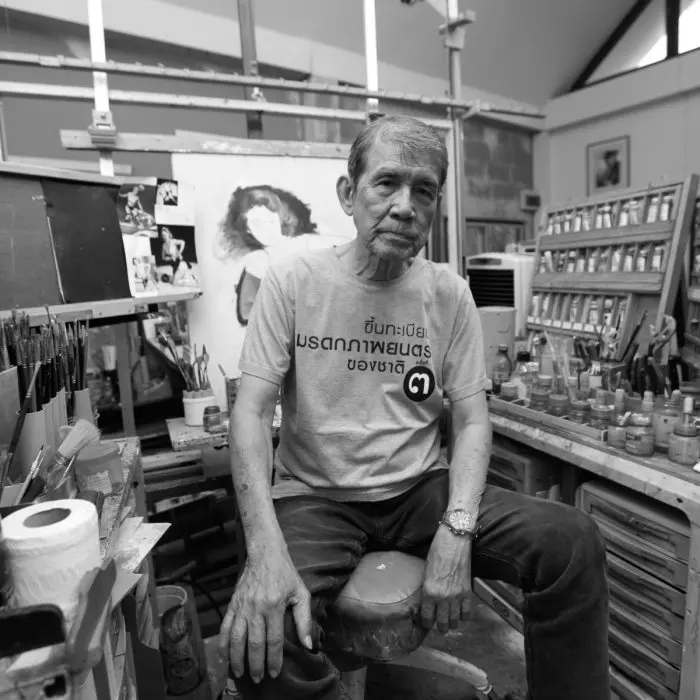
Thai cinema has lost one of its most distinctive figures. Somboonsuk Niyomsiri — known to generations of moviegoers simply as 'Piak Poster' — died on 24 September at his home, less than a month before his 94th birthday. He had been named a National Artist in 2015, one of the country's highest cultural honours.
Piak's story begins with paint, not film. Born in Bangkok, he studied at the Poh Chang Academy of Arts and started painting advertisements at 17. In the early 1950s, a movie promoter asked him to paint actors onto cinema billboards, and the work stuck. Over the following decades he produced more than 1,000 hand-painted posters and billboard cut-outs for Thai and international films, his vivid, montage-heavy style so recognisable that the nickname became his professional identity.
In 1970 he moved behind the camera with 'Tone', a drama following a poor temple boy in Bangkok. Made without studio backing or big stars, it became an unexpected hit and is now seen as a landmark of Thailand's 35mm era. Follow-ups 'Duang' (1971) and 'Choo' (1972) sealed his reputation, and his 1976 teen comedy 'Wai Olawon' helped kick off a wave of youth-focused Thai films. He directed 29 films in total, wrapping up with 'Bin Laek' in 1995.
Piak's influence ran deeper than his own credits. During a three-month internship at Japan's Daiei Film, he picked up storyboarding — a technique he then introduced to Thai filmmaking. He also acted, winning a Bangkok Critics Assembly best supporting actor award for 'Top Secret: Wairun Phan Lan'. Perhaps most importantly for film lovers, he helped establish the Thai Film Archive and in 1984 became its first donor, handing over reels, documents and equipment so future generations could study the medium.
After retiring, he left Bangkok for Pak Chong in Nakhon Ratchasima and returned to his first love, painting portraits. 'Making movies was a great ride, but now I am happy to do what I love again,' he told the Bangkok Post before receiving his National Artist honour.
For travellers, Piak's life is a reminder of how much visual culture waits beyond Thailand's beaches and street food. His posters belong to an era when cinema billboards were painted by hand, and his films offer a window into Bangkok before the skytrain. The Thai Film Archive in Salaya, on the capital's western edge, grew out of the preservation effort he championed and screens classics alongside contemporary Thai work — a rewarding detour for anyone interested in the country's film history. Fans of his era might also time a visit around retrospective screenings, which the Archive and Bangkok cinemas have regularly mounted for National Artists.
A single life, but two artistic careers: the man who painted Thailand's movie-going imagination, then went on to film it.