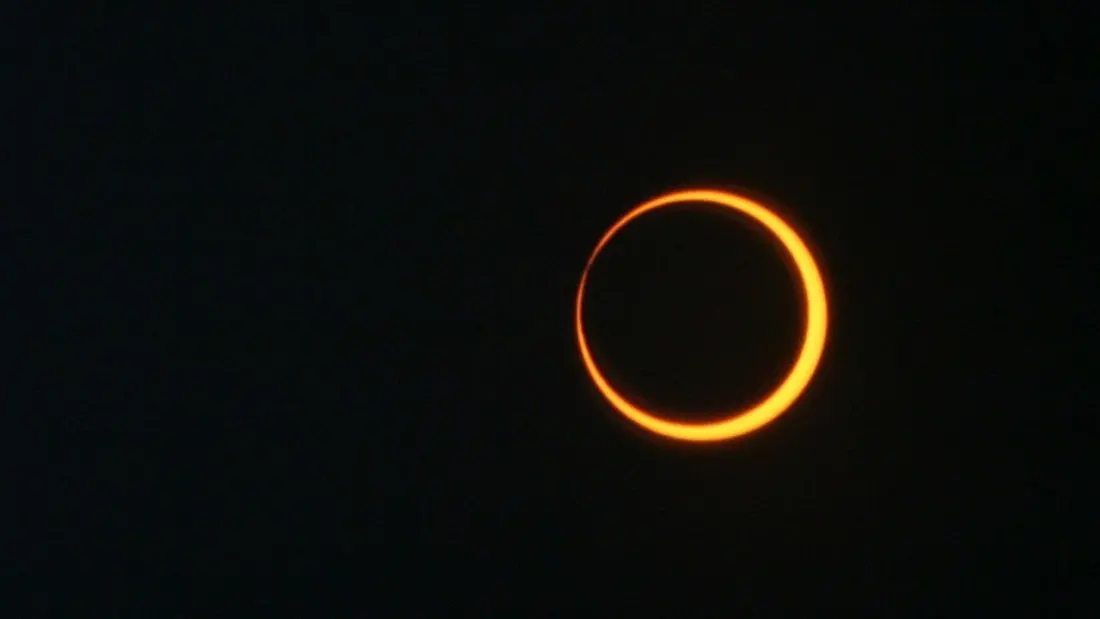
Mark 6 February 2027 in your calendar. On that Saturday afternoon, an annular solar eclipse — the so-called ring of fire — will sweep across West Africa, and southern Ghana sits squarely inside the narrow track where the full effect is visible. At roughly 5:52 pm, the Moon, appearing slightly smaller than the Sun because of its orbital distance, will leave a glowing ring of sunlight around its edges for a few minutes.
The maths is remarkably precise. NASA puts the path of annularity at about 282 km wide at its greatest point. In central Accra, the partial eclipse starts around 4:41 pm, the ring phase runs from roughly 5:49 to 5:55 pm — about five and a half minutes — and the Sun sets at 6:12 pm while the eclipse is still technically in progress.
Here's the catch for viewers: at maximum eclipse the Sun will be a mere 4 degrees above the western horizon. That's lower than most skylines. A single building, tree line or poorly chosen terrace can wipe out the whole show, so picking a spot with an open west-southwest view matters as much as being in Ghana at all. Cape Coast, also inside the path, gets a slightly longer ring phase — around 5 minutes 38 seconds — and pairs the astronomy with one of the country's most historic stretches of coastline, home to Cape Coast Castle and Elmina Castle.
Cross the border and the picture changes fast. Abidjan in Ivory Coast sits near the edge of the track, so despite similar timings, central Abidjan gets only around 51 seconds of annularity — a useful illustration of how sharply the duration drops off toward the path's fringe. Togo, Benin and Nigeria also see partial or annular phases depending on position.
Weather is the wildcard. February is Ghana's dry season, which sounds promising, but the Harmattan — a Saharan dust wind common from December to February — can haze out the low Sun even under cloudless skies. Astronomy is predictable; the atmosphere is not, so anyone travelling specifically for the eclipse should manage expectations.
One non-negotiable: eye protection. Because the Sun is never fully covered during an annular eclipse, certified ISO 12312-2 solar viewers are required at every stage. Regular sunglasses and improvised filters offer no protection, and cameras or telescopes need properly mounted solar filters. Bring glasses from home rather than gambling on last-minute supplies.
Specialist operator Young Pioneer Tours has built a Ghana Gold Coast and Solar Eclipse Tour around the date, running 2–7 February 2027, with stops at Black Star Square, the Kwame Nkrumah Mausoleum, the Akosombo Dam, Kakum National Park's canopy walkway and the slave-trade forts, plus an organised viewing with glasses included. An Ivory Coast Essentials Tour departing Abidjan on 7 February can be combined afterwards. Even if you travel independently, the pitch stands: a dependable celestial event is a rare excuse to build a West African trip around, and five and a half minutes of ring of fire over the Gulf of Guinea is a memorable payoff.