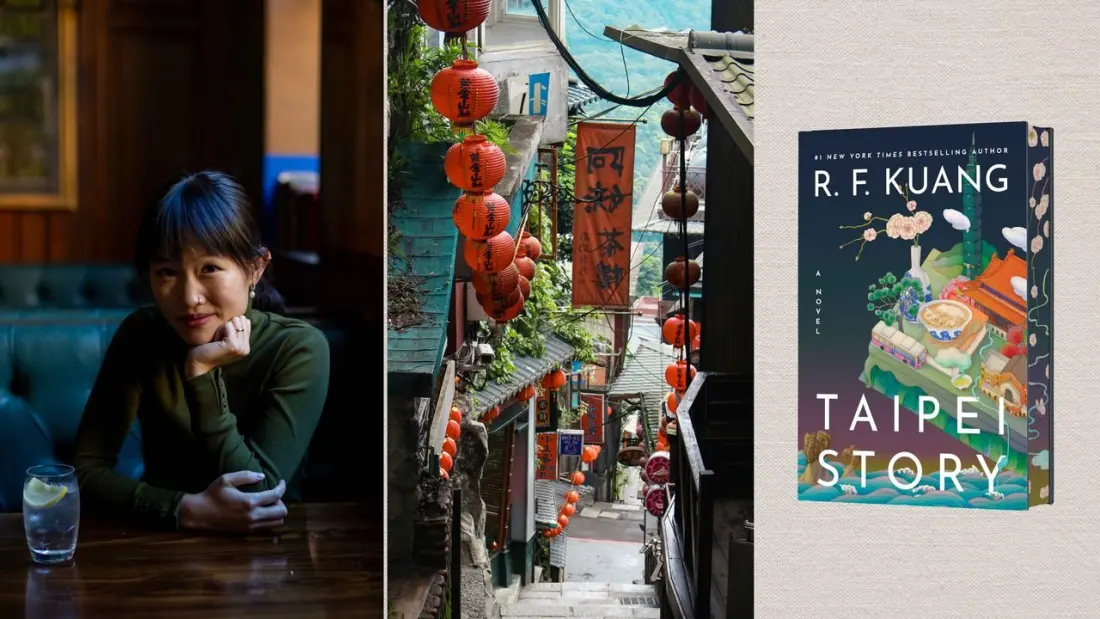
Novelist RF Kuang — best known for Babel and the Poppy War trilogy — has a new book out called Taipei Story, and it doubles as a sharp, funny portrait of what it actually feels like to arrive in a place you think you're entitled to know.
The premise: Lily Chen, a Chinese-American freshman at Yale, trades New Haven for a summer of intensive Mandarin study in Taipei. Her logic is familiar to plenty of diaspora kids — she believes perfecting the language of her heritage will fix whatever feels missing at home. The catch, and the book's central irony, is that Lily's family is from the mainland, not Taiwan. No one in her family has ever set foot there. Her fantasy of homecoming starts unravelling from the moment she lands at Taipei Taoyuan airport, souvenir halls and all.
Kuang told Condé Nast Traveller the novel grew out of her own experience: she was in Taiwan grieving her grandfather, enrolled in a language program, and wandered the city with no research agenda — joining crowds, stumbling into screenings at the National Concert Hall, ending up in bookstores she didn't know existed. Those accidental discoveries became Lily's route through the city, alongside stops like the hot springs of Beitou, the Chiang Kai-Shek Memorial Hall (where Lily's American friends awkwardly debate whether he's 'a good guy'), and, later, packaged day trips booked through Klook to the Pinglin Tea Museum and Yehliu Geopark.
One of the book's more moving arguments: embarrassment is good for you. Lily spends much of the summer afraid to get things wrong — quietly Googling restaurant recommendations in the bathroom rather than admitting she has no idea. By the end, after her grandfather's death collapses her original motivation entirely, she stops trying to become a version of herself that never existed. Freed from the homecoming fantasy, she simply enjoys being a tourist on a bus with families from Philadelphia, and learns more than she did while chasing fluency.
Kuang also credits Taiwan's everyday absurdities — particularly the island's wonderfully garbled 'Taiwan English' signage, inspired by a photo blog from author Tao Lin — as part of the city's charm, along with the modern Taiwanese authors she read for context: Wu Ming-yi, Bai Xianyong, Chen Yingzhen and others, most of them available in English translation.
For travellers, the takeaway is refreshingly anti-aspirational. You don't need heritage, fluency, or a flawless itinerary to earn a place in Taipei. The city rewards the person willing to join a queue without knowing what's at the end of it — and the book works as a wry companion read for anyone heading there, especially travellers navigating the messy overlap between curiosity, identity and tourism in Taiwan.
The interview was originally published on Condé Nast Traveller UK.