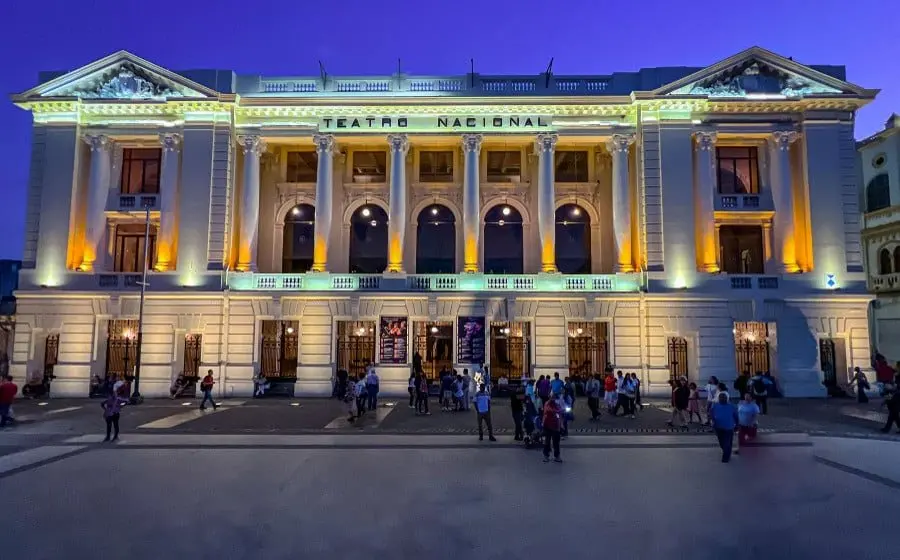
San Salvador's historic center holds a building that survived fires, earthquakes and decades of mixed use to remain the country's most important stage: the National Theater of San Salvador, known locally as the Teatro Nacional.
The story starts in the 19th century. The capital's first National Theater opened in 1867 and hosted opera companies, musicians and poets until a fire destroyed it in 1910. Rather than give up, the city ran an international design competition, won by French architect Daniel Beylard, with Alberto Ferracuti overseeing construction. President Manuel Enrique Araujo laid the cornerstone in 1911 as part of centenary celebrations of the 1811 independence uprising, and President Carlos Meléndez inaugurated the finished building in 1917.
The theater's life since then has been eventful. Parts of it once housed government offices and Radio Nacional, and it even ran as a cinema. A major 1970s restoration added the Pequeña Sala and Sala de Cámara, with the renovated venue reopening in November 1978. The earthquakes of January and February 2001 caused serious damage, and it took until 2008 to fully reopen after another round of repairs. El Salvador's Legislative Assembly declared it a National Monument on February 16, 1979, a meaningful distinction in a city where earthquakes and neglect have erased many historic structures. The Ministry of Culture now runs it as both a protected monument and a working venue.
Architecturally, it's usually described as French Renaissance, though it's more precisely an eclectic Neo-Renaissance design. One reason it's still standing is forward-thinking engineering: builders used the Hennebique reinforced concrete system, an innovative method that has helped the structure endure multiple earthquakes. Outside, the symmetrical facade with its tall windows, columns and arched openings faces Plaza Morazán — worth viewing from across the square before you go in. Inside, look up. Carlos Cañas' ceiling mural El Mestizaje Cultural, painted during the 1970s restoration, adds a distinctly Salvadoran voice to a European-style building, and a crystal chandelier hangs beneath it.
The Gran Sala is the centerpiece: a horseshoe-shaped auditorium with roughly 650 seats across three levels, decorated balconies, an ornate presidential box, and acoustics that drew praise as far back as the 1917 inauguration. Smaller spaces — the Pequeña Sala, Sala de Cámara and a casual Café Teatro — host intimate productions, poetry readings and music, while the foyer doubles as an exhibition area.
For visitors, there are several ways in. Guided tours introduce the building's history and rooms when available; checking the Ministry of Culture's schedule lets you catch a play, concert or ballet. Hours, prices and tour times change, so confirm details ahead, especially around holidays.
The location makes it an easy anchor for a day downtown. Plaza Morazán sits right in front, the National Palace and the Metropolitan Cathedral — home to the tomb of Saint Óscar Romero — are a short walk away, and the modern BINAES library, El Rosario Church with its vivid stained glass, and Plaza Libertad round out a compact walking route through centuries of the city's history.
If you can, book a show. This is a building best experienced the way it was designed to be used, with the stage lights on.