Riesling may be Germany's calling card, but the country has 13 wine regions covering roughly 100,000 hectares and more than 100 grape varieties — from slate cliffs to volcanic soils, some slopes so steep they can only be worked by hand. A new wave of young winemakers is taking over family estates, and natural wine now sits comfortably beside centuries-old traditions. Here's a quick tour of seven regions that reward more than a single tasting.
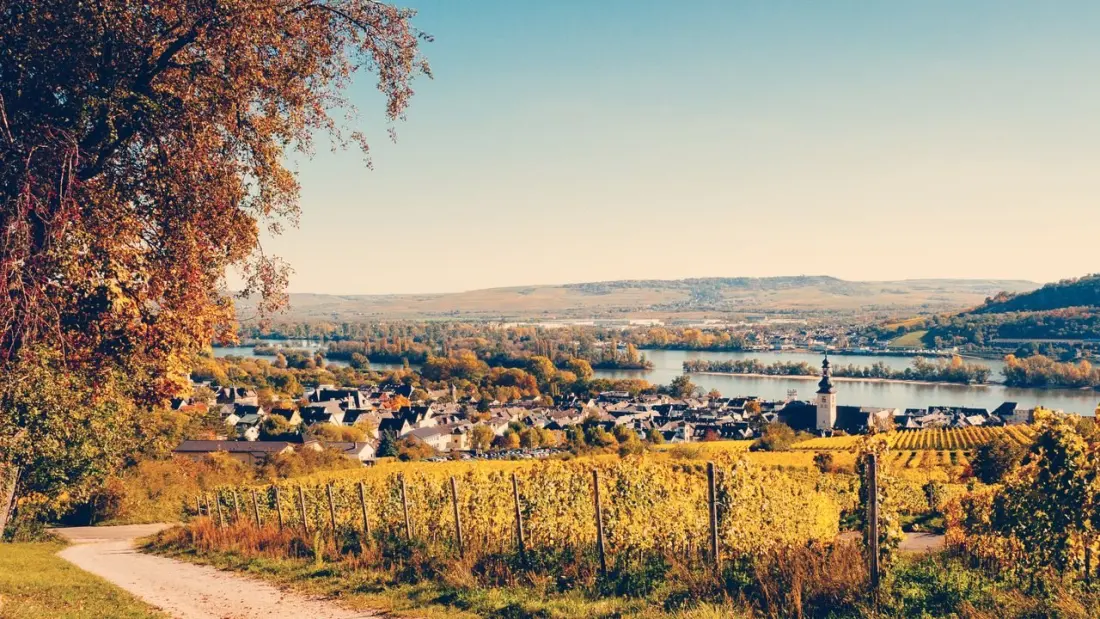
The Moselle is the showstopper: vertiginous vineyards looping along the river from Koblenz towards Luxembourg, including the Saar and Ruwer valleys. Viticulture here goes back to Roman times — Trier, Germany's oldest city, has the Porta Nigra and Imperial Baths to prove it. Near Bremm you can hike the terraces of Calmont, Europe's steepest vineyard, and the wines are mineral-led, delicate Riesling.
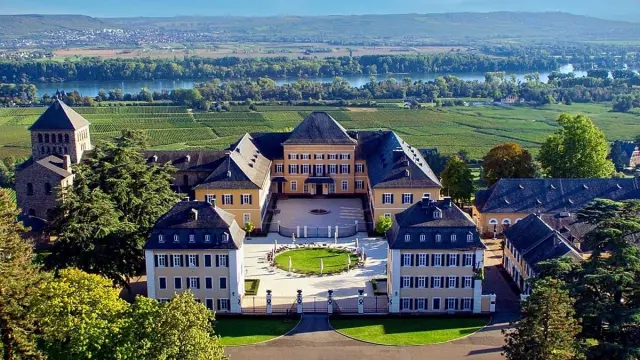
The Rheingau is the classicist, with just 3,100 hectares but serious pedigree. Cistercian monks shaped viticulture here in the Middle Ages, and Eberbach Abbey near Eltville still has one of Germany's oldest wine cellars (and a film credit in The Name of the Rose). Johannisberg Castle was named the Best Vineyard in the World for 2026 in the 50 Best Vineyards Awards. Expect dry, full-bodied Riesling.
For sunshine, head south to the Kaiserstuhl in Baden, an extinct volcano in the Upper Rhine Graben with a climate zone that matches parts of France. Baden is Germany's third-largest region at around 15,000 hectares, and leans red — its Pinot Noir is considered some of the best Burgundy-style terroir outside France. The architecture is a draw too: the Abril winery near Vogtsburg-Bischoffingen wears a bold rust-brown Corten steel facade.
The Palatinate, Germany's second-largest region at 23,000 hectares, is the party of the group. The 85-kilometre German Wine Route, established in 1935, runs from Bockenheim to Schweigen past almond trees that bloom in early spring, and Bad Dürkheim hosts the Wurstmarkt, the world's largest wine festival. Riesling leads, but Pinot Noir and Dornfelder are on the rise.
The tiny Ahr valley — just 550 hectares — is Germany's red wine heartland, famed for mineral Pinot Noir and the rarer Frühburgunder. Devastated by floods in July 2021, the valley has largely reopened and hiking the Red Wine Trail between Mayschoß and Altenahr is a way to support its recovery.
Saale-Unstrut, one of Europe's northernmost wine regions, pairs terraced vineyards along the Saale and Unstrut rivers with cultural heavyweights like UNESCO-listed Naumburg Cathedral. Try the Pinot Blanc and Silvaner.
Finally Rheinhessen, the largest at nearly 28,000 hectares and nicknamed the Land of 1,000 Hills, has shed its Liebfrauenmilch reputation thanks to a generation of young natural-winemakers selling direct. A bike tour through the Wonnegau links the hills — and more cellar doors than you can sensibly visit in a day.
Who's it for? Essentially everyone: drama-seekers should pick the Moselle, history buffs the Rheingau, sun-lovers Baden, and anyone chasing the next big name in natural wine should point themselves at Rheinhessen.