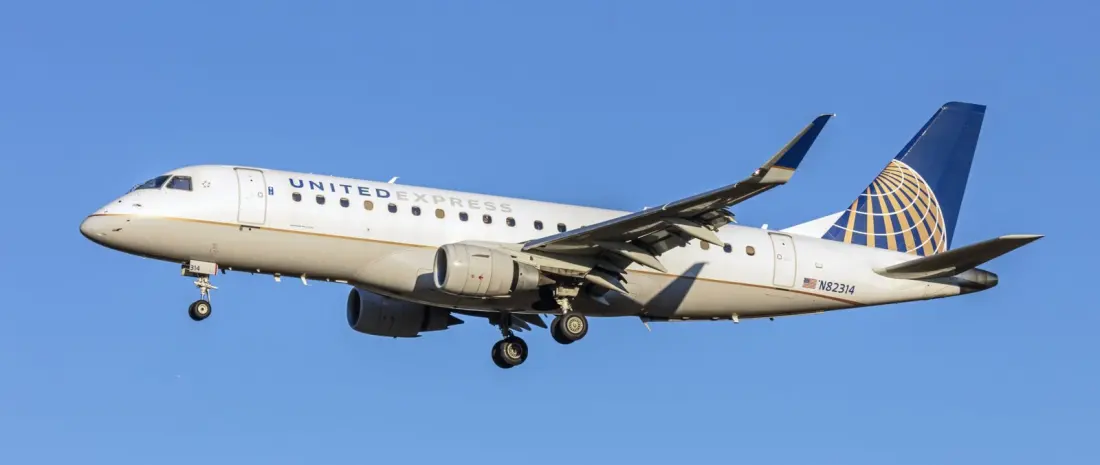
A routine hop across Texas turned into an emergency on Sunday 27 September 2026, when the cockpit windshield of a regional jet cracked through completely shortly after leaving Houston. United Airlines Flight 6309, operated by Mesa Airlines with an Embraer E175, had departed George Bush Intercontinental Airport at 12:20 pm bound for El Paso International Airport when the first officer's windshield failed.
This was not a minor blemish. In air traffic control recordings picked up by ABC News, a pilot can be heard requesting an immediate altitude hold and declaring an emergency, noting that the glass had broken all the way through rather than a single layer, and that pieces were falling into the cockpit. The crew slowed the aircraft to 210 knots and turned back toward Houston.
The plane touched down safely at 1:00 pm, roughly 40 minutes after take-off, and taxied to the gate with Houston Fire Department crews waiting to inspect the damage. Nobody was hurt, and there was no loss of cabin pressure. Passengers were rebooked onto a replacement aircraft, which reached El Paso at 3:14 pm according to Flightradar24. Once the windshield was swapped out, the aircraft was cleared to fly again.
Mesa Airlines told CNN that returning to the field is standard procedure when a windshield shatters, even without depressurisation. The FAA has opened an investigation into what caused the failure. Cockpit windshields are built from multiple layers of tempered glass and other materials specifically to survive impacts and temperature swings, so a single cracked layer does not normally compromise the aircraft. What made this event unusual was glass coming loose inside the cockpit. Possible culprits include faulty installation, electrical faults in the anti-ice heating system, or simple wear over time.
It is also not an isolated scare. In October 2025, a United flight made an emergency landing at Salt Lake City after its windshield was struck by an object, injuring the pilot with glass shards. Weather balloon company WindBorne Systems suggested at the time that one of its balloons may have been to blame.
For travellers, the takeaway is mostly reassuring: crews train for exactly this scenario, multi-layer windshields are designed with redundancy in mind, and the system worked as intended — an early turn-back, a safe landing, and passengers on their way the same afternoon. Delays from diversions like this are inconvenient but rarely dangerous, and airlines typically move passengers to another aircraft within hours, as happened here.