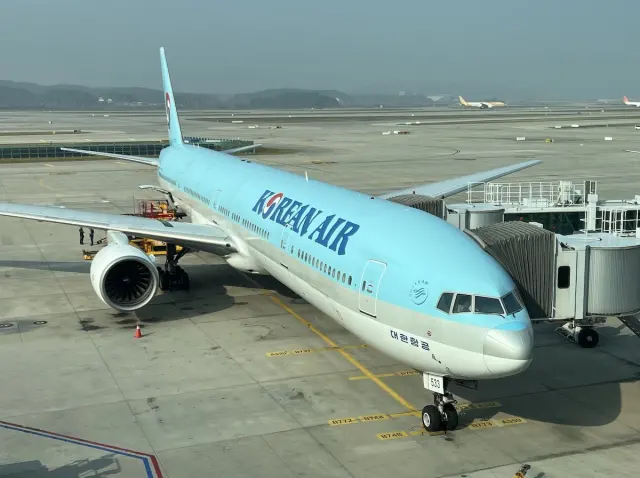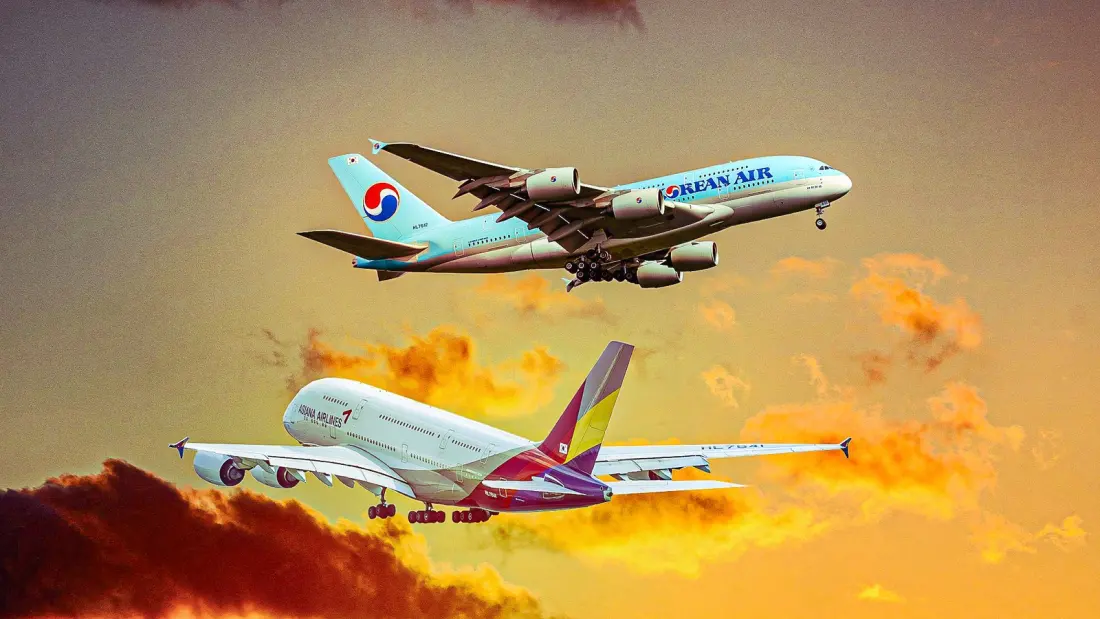
Korean Air is expected to fold Asiana Airlines' six Airbus A380s into its own fleet of five by the end of the year, creating one of the biggest superjumbo operations over the Pacific. But the two Korean airlines configured their A380s very differently — and if you've been putting off flying the world's largest passenger plane, the clock is ticking.
Asiana's A380s are the denser of the pair, with 495 seats: 12 Business Suite seats (originally sold as first class, now premium-priced business) on the lower deck, 66 Smartium business seats upstairs, and 417 economy seats. Korean Air went the other way with just 407 seats — 12 Kosmo first-class suites, 94 business seats in a 2-2-2 layout occupying the entire upper deck (complete with a bar/lounge), and 301 economy seats downstairs. When delivered, Korean's was the least-seated A380 of any airline.
There's a catch for comfort-seekers, though: these cabins are old. Neither carrier offers premium economy, Korean's first suites lack doors, and its window business passengers have to climb over a neighbour. That's a world away from Emirates and British Airways, both of which are reconfiguring their A380s with premium economy — a cabin Emirates says sells "like hot cakes". Korean has no plans to refresh its superjumbo cabins; the airline would rather be rid of them entirely. Retirement was originally planned for 2026 but slipped to 2029-2031 (Asiana's: 2028-2030) purely because replacement aircraft — A350s, 787s and the much-delayed 777-9 — keep arriving late. Another industry downturn could pull those dates forward; Qantas has already brought its own A380 retirement forward to 2028.
Where can you actually fly them? Everything operates out of Seoul Incheon, and the focus has shifted firmly to the transpacific. Korean's A380s fly daily to New York-JFK and up to daily to Los Angeles, with occasional regional hops to Tokyo Narita, Taipei and Hong Kong. Asiana's run daily to Los Angeles, seasonal flights to New York, and a final seasonal run to Sydney; European routes like Frankfurt have already been switched to twinjets. Once the merger completes — Asiana's brand disappears in mid-December 2026 — the superjumbos will be repainted in Korean Air colours and the two fleets will complement rather than compete on the LA and New York routes.
For travellers, this is a window that's closing. If you want an upper-deck business seat with a lounge, a Korean Air Kosmo suite, or simply a ride on a four-engine giant on a transpacific trunk route, book sooner rather than later. The A380 is already down to a handful of operators in the Indo-Pacific — Singapore Airlines (12 aircraft), Qantas (10), ANA (just three) — and China Southern has scrapped its fleet entirely. Korea will be one of the last places to catch the superjumbo over the Pacific, likely for only a handful more years.