Washington's autumn crowds are chasing golden larches, and the state's most popular trails are paying the price — packed lots, gridlocked roads, queues of hikers. Meanwhile, on the quiet side of Mt. Baker, there's a 20.5-mile loop that delivers all the colour of fall without a single traffic jam: not from leaves, but from mushrooms.
The route combines the Ridley Creek, Bell Pass, and Elbow Lake Trails in the Mt. Baker Wilderness, with about 3,870 feet of climbing. Writer Zoe Gates hiked it as an overnight in mid-October and reported having the place to herself. Instead of leaf-peepers, she found the forest floor at peak fungal display — chanterelles, king boletes, violet webcaps and bear's head tooth fungi in yellows, rusts, purples and white — plus moss deepening to emerald as the wet season begins.
Getting there takes a bit of extra effort. A washout has closed the forest service road to both trailheads, so you park at a pullout at milepost 7 on Middle Fork Nooksack Road (a Discover Pass is required) and walk or bike 3.7 miles of gravel along the river. Bikes can be stashed near the Elbow Lake trailhead before walking the final 1.4 miles to Ridley Creek. A rope-railed log crossing over the Middle Fork Nooksack gets you onto the trail — though these crossings wash out seasonally, so check conditions.
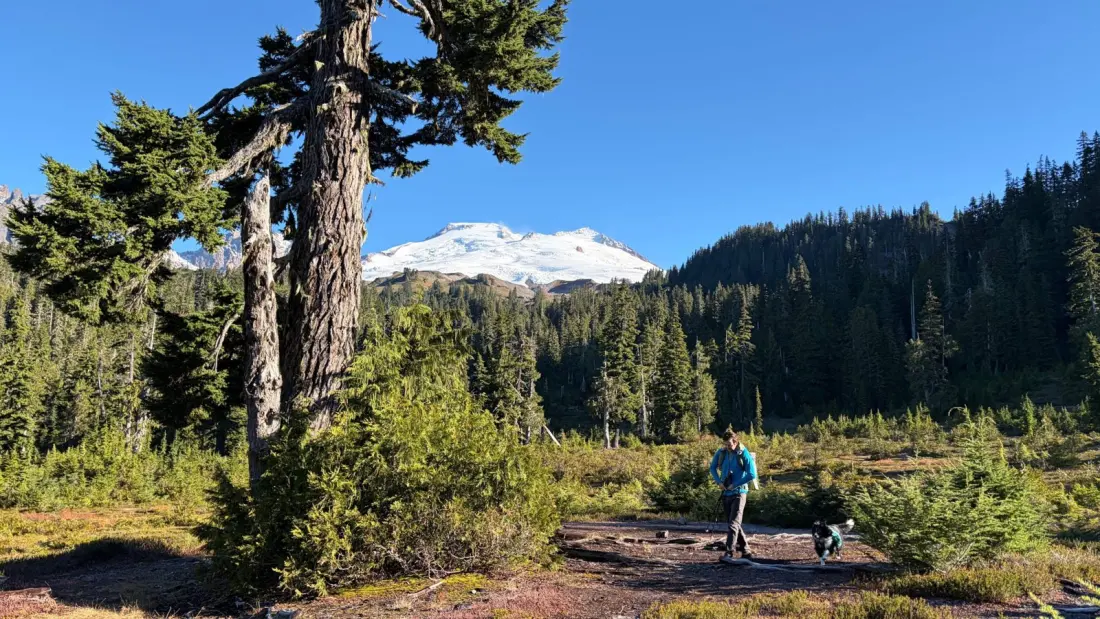
From there it's steep switchbacks through old-growth, then subalpine meadows, reaching Mazama Camp after roughly 8 miles from the car. The camp has a log shelter and scattered tent sites with wide-open views: the Easton and Squak glaciers on Mt. Baker turn pink at sunset, and the apricot dunite crags of the Twin Sisters glow to the west. Ambitious hikers can add a 3-mile round-trip, 950-foot detour to the Park Butte fire lookout. Day two covers the Bell Pass Trail (4.4 miles) to Elbow Lake — good swimming-hole-of-a-lunch spot at the neck between Elbow Lake and Lake Doreen, with more campsites nearby — then about 3 miles back to the road, including a second, trickier log crossing.
Fair warning: this is a rougher, quieter trail by design. Expect overgrown sections and blowdowns, especially on the upper Elbow Lake Trail, though local volunteer crews have kept the route navigable. That wildness is exactly the appeal — a genuine wilderness feel an hour's drive from Bellingham, while everyone else fights for parking at the larch hotspots.
For anyone planning an autumn trip to the Pacific Northwest, this is a template for beating the fall-crowds problem: pick the lesser-known drainages, go midweek or later in October, and you get glacier sunsets, mushroom-hunting and total silence. Bring a field guide — you'll want to name what you're looking at.