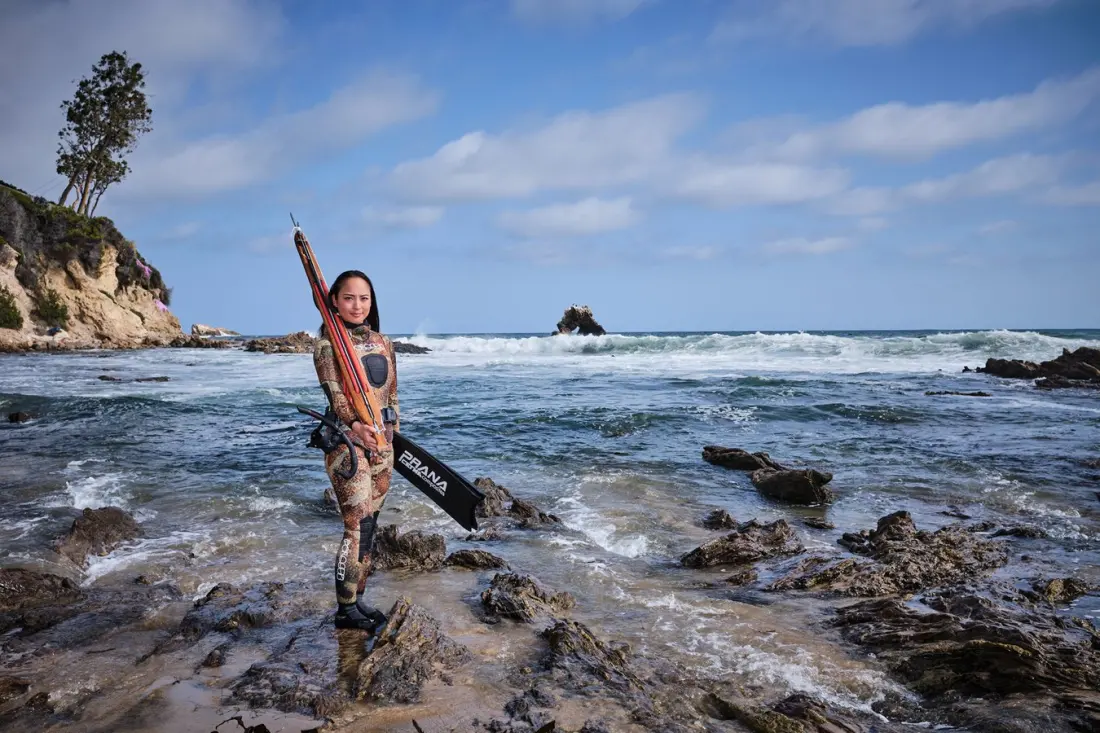
A near-75-pound white sea bass is a serious fish by any measure. For Mitsuki Hara, a Japanese-born athlete based in Southern California, it was also a record — and proof that spearfishing, long the domain of big, muscular 'hunting dudes' in her words, belongs to women too.
Hara's route into the water started with a cheap-lobster problem. As a student at UC San Diego, she spotted a man hauling a lobster bag out of the surf and, priced out of the seafood counter, asked him to show her where the lobsters lived around La Jolla. Her first attempts were failures — she couldn't dive at all — but the community stuck with her. Today, she calls her fellow divers family, given that her relatives are all back in Japan. They catch together, then cook together.
The sport itself is simpler than it sounds, and harder. There are no scuba tanks. Divers free-dive anywhere from 10 or 20 feet down to 60 or 70, stay still, and wait for fish to swim past — sometimes diving four or five times before landing a target. Hara describes it as more lifestyle than sport: if you're only in it for the fish, you'll be disappointed. She's also strict about sustainability, taking only what she can eat herself, a pointed contrast with commercial fishing.
Why California? Hara has lived around the world and argues the state's coastline is hard to beat. Mendocino and Monterey offer entirely different species, water temperatures and currents from San Diego, and she notes you can technically snowboard, catch trout and spearfish in a single day. For travellers, that means one trip can span kelp forests teeming with sea bass, cooler northern waters, and inland mountains — all within a few hours' drive.
Her hardest-earned lesson is one any ocean traveller can use: the sea won't always cooperate. Currents turn strong, fish turn out bigger than expected, and panic sets in. The fix, she says, is counterintuitive — slow down, breathe properly, make calm decisions under stress. It's a skill she credits with improving her life on land too.
Anyone curious about trying the sport should note the physical reality: getting gear to the beach means hauling 12-to-20-pound weights, and the fish themselves often run 30 to 40 pounds. But Hara's own story — a bad swimmer who became a world-record holder — is the strongest possible argument that beginners have a place in the water. And if her visibility convinces even one more woman to give it a go, she says, that's worth it.