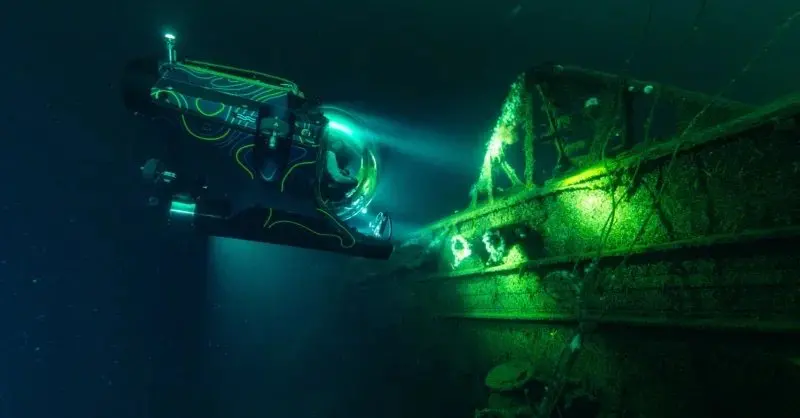
In a Norwegian fjord this year, explorers from expedition company Cookson Adventures descended in a manned submersible to view Second World War warships that had sat untouched for more than 80 years. Organisers say it was the first time those particular wrecks had been explored this way — a sign of where high-end adventure travel is heading: downwards.
The appeal is obvious once you understand what a submersible actually does. Recreational scuba tops out around 130ft, with strict time limits. A crewed submersible keeps passengers in a pressurised cabin at surface pressure, so there's no decompression, no diving qualification needed, and you can stay down for hours. Erik Hasselman, Cookson's head of yachts and a veteran of 250-plus dives to depths of 3,470ft, points out that anyone from grandparents to children can take part. His favourite targets: historic wrecks, deep twilight-zone reefs and polar waters, where life under the ice is richer than most people expect.
After the 2023 implosion of OceanGate's Titan, which killed all five aboard during a dive to the Titanic, safety is the conversation. The US Coast Guard's investigation, published in August 2025, called the tragedy preventable, citing failures in engineering, certification, maintenance and inspection. Hasselman says clients are now better informed and ask harder questions — which he considers a good thing.
For anyone considering a dive, the checklist is fairly clear-cut. The vessel should be classed by a recognised society such as DNV, ABS or Lloyd's Register, with a current certificate. Ask about the pilot's hours on that specific model, maintenance records, life-support reserves, tracking and communications, and emergency procedures. Hasselman flags the launch and recovery system as a place where real risk often sits, and stresses the value of knowing who has authority to cancel a dive. In remote spots, planning should cover medical access, evacuation routes and the nearest hyperbaric chamber. His mantra: a culture where anyone can say no to a dive builds more trust than pretending risk doesn't exist.
What about owning one? Manufacturers like U-Boat Worx, Triton Submarines and SEAmagine sell craft from compact recreational models to deep-diving specialists. But the purchase price is only the start: you'll need at least two trained pilots, a dedicated technician, annual classification surveys and periodic overhauls. Some expedition yachts now integrate subs from the design stage — the near-150ft Hakvoort explorer Milele was built around its owner's two-person U-Boat Worx craft, tucked under a foredeck hatch. Still, Hasselman reckons chartering as part of a well-run expedition suits most people: you can always buy later, and you'll choose better after trying.
The bigger picture is that very little of the deep sea has ever been seen. NOAA figures show less than 29% of the seafloor mapped in high resolution as of April 2026, and under 0.001% of the deep-ocean floor visually surveyed. Cookson is betting private expeditions can help close that gap, pairing guests with scientists — upcoming plans include dives on Malta's First and Second World War wrecks with maritime archaeologist Professor Timmy Gambin, plus more research around Narvik, Norway.
For travellers who've ticked off the usual bucket list, the deep offers something genuinely new — as long as you pick your operator with care.