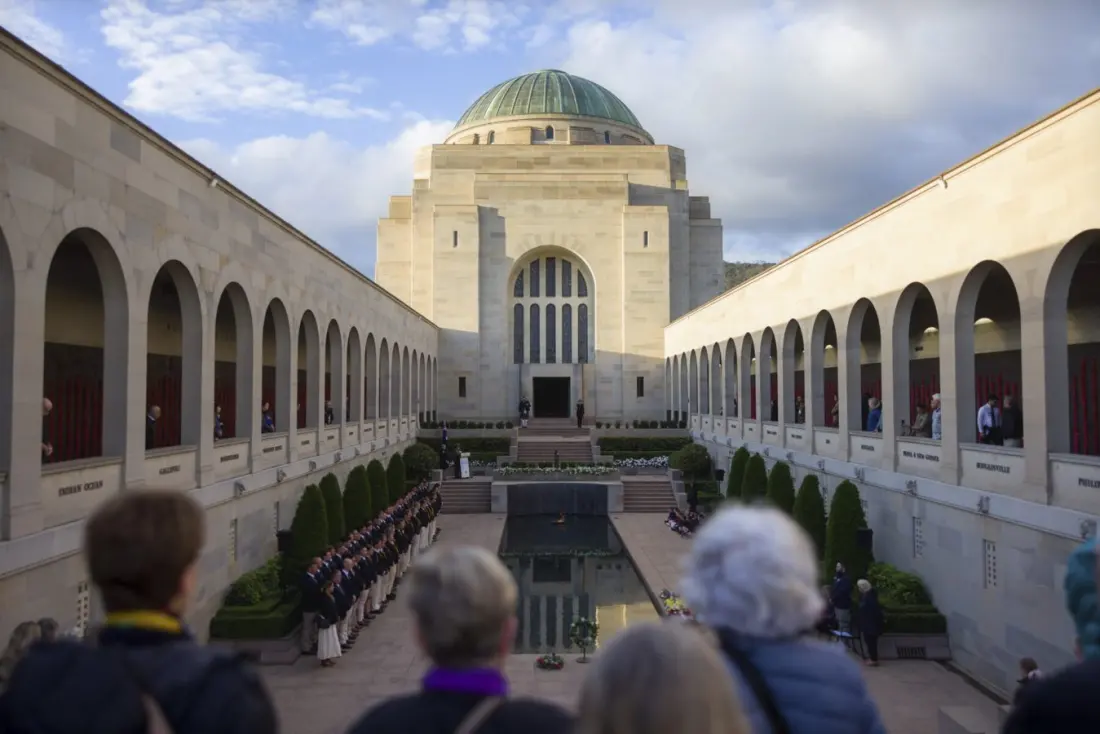
Australia's most-visited memorial has just had its biggest makeover yet. After a $500 million-plus expansion that began in 2020, the Australian War Memorial in Canberra has unveiled new galleries, a striking Anzac Atrium and hundreds of artefacts the public has never seen before. Even the beloved bronze of Simpson and his donkey is back, now greeting visitors at the new main entrance.
The numbers are striking. Anzac Hall alone holds more than 3,700 objects, roughly 70 per cent of them displayed for the first time. The atrium's sandstone came from the same quarry as the original 1941 building, and its ceiling design echoes the Army's Rising Sun badge. Towering over the space are some of the collection's heavyweights: a Black Hawk helicopter, an RF-111C aircraft that flew over East Timor in 1999, a light armoured vehicle from Iraq and Afghanistan, and the HMAS Brisbane destroyer that served in Vietnam and the Gulf.
Three new permanent galleries cover Australian peacekeeping since 1947, conflict in the Middle East from 1990, and the war in Afghanistan — home to a Chinook helicopter and the Bushmaster known as 'Debbie'. History buffs will find plenty further back, too. The Sydney Harbour Under Attack exhibition features one of the Japanese midget submarines that slipped into the harbour in June 1942, personal mementos and all. Over in the Bomber Command gallery sits the famous Lancaster 'G for George', alongside a WWII V-2 rocket on its original launch platform — in the collection since the 1950s but never shown before.
What makes the place special, though, is the storytelling. More than 120 volunteer guides, many of them defence veterans, run tours tailored to your interests; guides train for nine months before earning accreditation. Their tours often begin at the Roll of Honour, where 103,000 names are commemorated — the average age is 23, and the youngest, James Martin, died at Gallipoli at 14 years and nine months. One guide's favourite: Richard Martin, an Aboriginal soldier who enlisted as a Māori because the Defence Act 1903 barred Indigenous Australians from serving. He died at Dernancourt in 1918, one of about 20,000 WWI servicemen with no known grave.
The memorial doesn't dodge complexity either. Displays cover the 2003 anti-war protests — including the red 'NO WAR' graffiti painted on the Sydney Opera House — and the Hall of Valour notes the ongoing legal case against Ben Roberts-Smith. A temporary exhibition on Operation Kudu, Australia's 2023 mission training Ukrainian forces, runs until August 2027.
Why should travellers care? This is now genuinely one of the country's best museums, and you could spend days here without seeing everything. It's also a solid reason to add Canberra to an itinerary that many people skip. Free entry, moving stories and world-class exhibits make it easy to understand why Australians keep coming back.