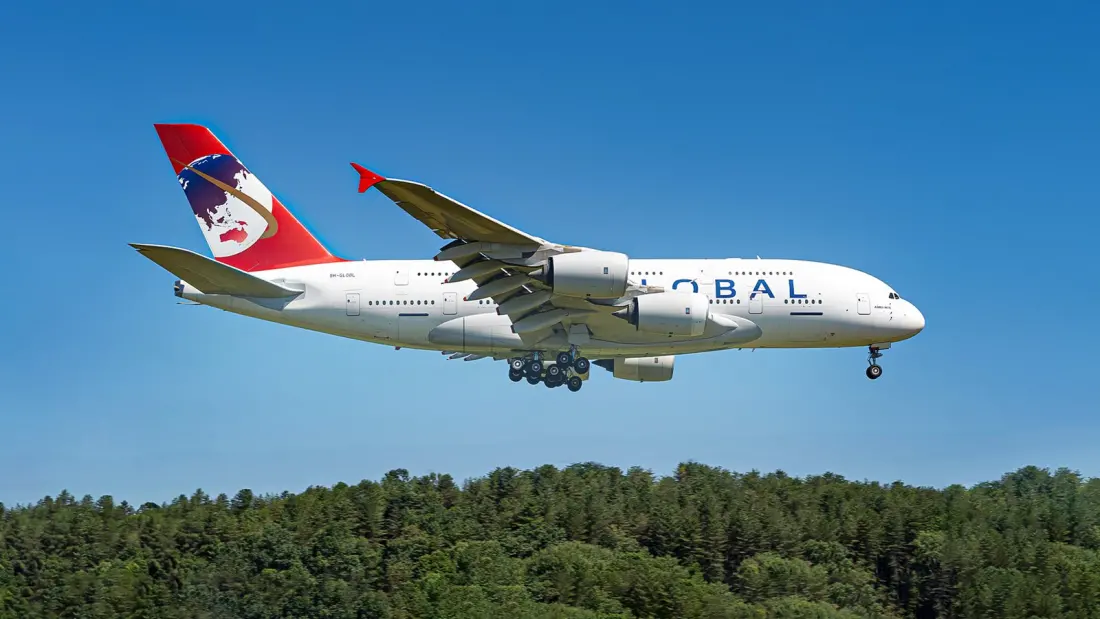
A British startup that promised to bring the Airbus A380 back to long-haul passenger flying may be about to run out of runway — in court rather than in the air. Global Airlines, which operates without its own air operator certificate, is facing a winding-up petition in London's High Court as creditors push to force it into compulsory liquidation.
The company's lone A380, registered 9H-GLOBL, has been parked at Tarbes-Lourdes-Pyrénées Airport in France since July 2025. Its commercial track record amounts to just four flights — two roundtrips flown under a damp lease with Hi Fly Malta — totalling 62 flight hours across 20 operational days. CEO James Asquith still insists the jet will fly again before Christmas 2026 on new UK-to-Maldives routes, but the paperwork tells a different story: a winding-up petition filed in May 2026, earlier High Court hearings before Insolvency Judge Barber in July and September, and a mandatory September 30, 2026 deadline to lodge audited accounts that will expose the balance sheet publicly.
The economics are brutal. Secondhand A380s trade for a seemingly bargain $25-60 million, but returning a dormant superjumbo to airworthiness requires heavy maintenance checks, engine recertification and structural inspections that can double that cost. Meanwhile, storage fees, insurance and corrosion control drain cash every month with no ticket revenue coming in. The company blames global backlogs for 12-year heavy maintenance checks, but the maintenance queue isn't the only obstacle — the startup still lacks a UK Air Operator Certificate, which means no control over schedules or route rights, and no access to valuable Heathrow or Gatwick slots, which coordinators only grant to licensed, liquid operators.
The boardroom has been turbulent too, with departures including OnlyFans co-founder Tom Stokely and former Chief Commercial Officer Richard Stephenson. And even if the airline survives, the jet itself faces a grim market. With Airbus ending A380 production at 251 aircraft, parts are scarce and legacy carriers pay well for spares — making a healthy, low-cycle airframe worth more disassembled than flying. Unlike twin-jets, the A380's double-deck layout rules out freighter conversion, so scrapping is the most likely outcome if creditors force a sale. Hi Fly's earlier A380 experiment ended the same way at the very same French airport, harvested for landing gear, avionics and Trent 900 engines.
Why should travellers care? Because it's a cautionary tale about flash in-flight promises — the startup flew glitzy transatlantic services while carrying debts it couldn't service, a reminder to book long-haul with carriers on solid financial and regulatory footing. It also likely closes the book on any independent, non-legacy A380 operations. If an airframe with refurbished cabins and low flight hours can't find a buyer, no startup will try this again. The future of budget-challenging long-haul belongs to fuel-efficient twin-engines; the four-engine giants are now firmly the toys of the big legacy networks — and, increasingly, of the parts brokers.
Simple Flying