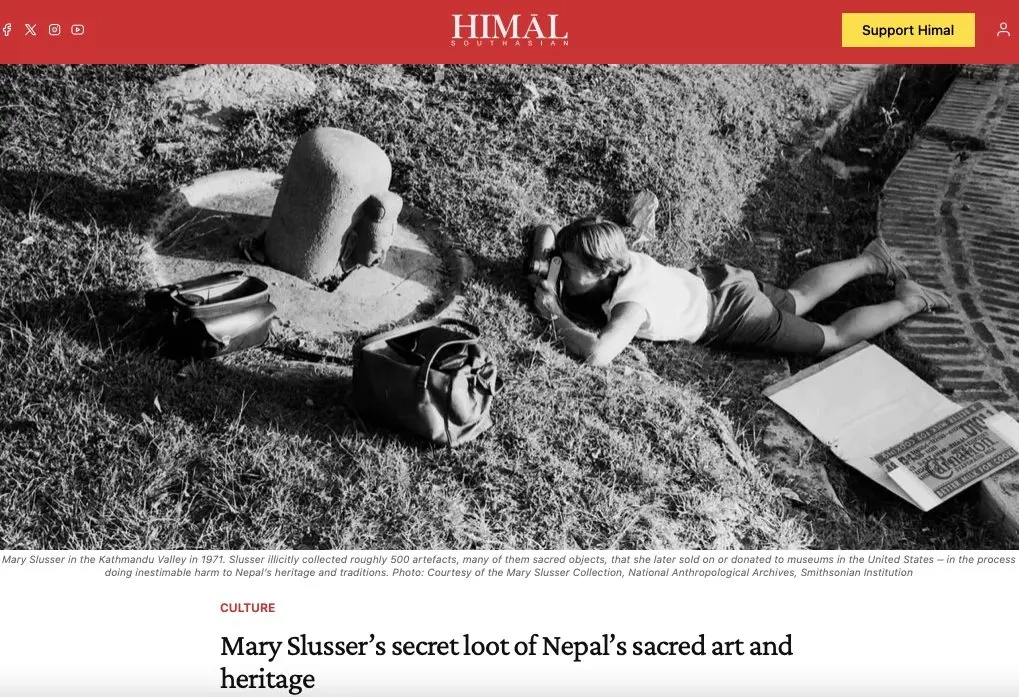
A new investigation in Himal Southasian by Erin L. Thompson has reignited a fierce debate in Nepal about the legacy of Mary Shepherd Slusser, the American art historian whose work on the Kathmandu Valley is considered foundational — and who, critics now argue, was deeply complicit in the export of Nepal's stolen heritage.
The story did not start with the September exposé. Back in 2023, criminologists Emiline Smith and Thompson published a paper in the International Journal of Cultural Property accusing Slusser of academic facilitation of the illicit antiquities trade. It drew a defensive rebuttal from scholar Charles Ramble in the European Bulletin of Himalayan Research, but the new piece has pushed the argument firmly into Nepal's public sphere.
The evidence is concrete. In 2001, Slusser told the Art Gallery of New South Wales in Australia that she held 1969 photographs of a shalabhanjika strut stolen from Ratneswor Temple in Patan — then suggested it 'had best be left on loan to Australia', effectively deciding Nepal's claim on its own deity's behalf. The gallery eventually returned the strut in 2023. Elsewhere, a 16th-century Buddhist scroll painting from Yampi Bihar in Patan, which Slusser photographed in 1967, later surfaced in the Virginia Museum of Fine Arts, with Slusser playing a key role in its acquisition. Nepal's Ancient Monuments Preservation Act, in force since 1956, already restricted exporting antiquities while she was living and collecting in the country in the 1960s and beyond — raising the obvious question of how so much left legally.
Writer Alisha Sijapati, writing in the Nepali Times, argues the truth is uncomfortable on both sides. Slusser produced indispensable scholarship and often framed her interventions as rescue from neglect and decay. But she also, in Sijapati's words, gatekept Nepali heritage — part of a wider colonial-like dynamic in which foreign experts named Nepal's gods, decided what counted as 'art' versus 'idol', and never consulted the communities still worshipping them. Local complicity matters too: weak institutions and a culture of treating foreign scholars as infallible left temple doors unlocked, figuratively and literally.
Why should travellers care? Anyone who has wandered Patan Durbar Square or admired Himalayan art in Western museums has seen the results of this system. The piece calls for repatriation to mean reinstallation — deities physically and spiritually returned to their original shrines, not just displayed in Kathmandu — and for a properly funded repatriation unit within Nepal's Department of Archaeology, since provenance research, legal dossiers and diplomacy are marathon work, not press-event photo ops. Slusser died in 2017, but her archives now serve a new purpose: a roadmap for Nepalis to trace, claim and reclaim what was taken. The investigation is also clear that she was one node in a larger network of dealers, scholars and intermediaries — and that the reckoning should not stop with her.