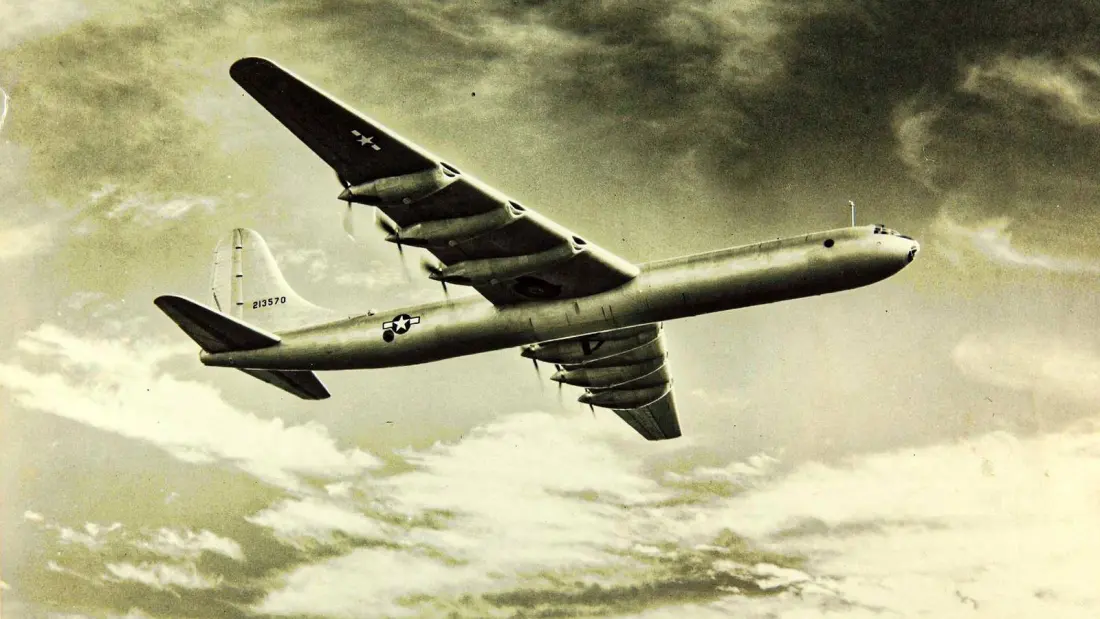
Only four complete examples survive today, scattered across US museums, of the biggest bomber America ever flew into service. The Convair B-36 Peacemaker carried the country's entire nuclear deterrent for a few short years, then vanished almost without ceremony. Its last flights came in 1959, just over a decade after it entered service with the Strategic Air Command in 1948.
The aircraft was absurdly ambitious. Its wingspan remains the longest of any combat plane in history, and it could haul nearly 44 tons of cargo 10,000 miles without refuelling — enough to reach the Soviet Union from the United States and come home. Six piston engines drove propellers mounted backwards on the trailing edge of the wings, and four jet engines were later hung near the wingtips, giving crews the catchphrase "six turning and four burning." Top speed with everything running: about 435 mph. It was also the only plane that could carry the Mark 17, the largest hydrogen bomb the US ever built, a weapon weighing over 41,000 pounds that needed a parachute to give the bomber time to escape the blast.
On paper it was irreplaceable. In practice it was a nightmare. The unconventional engine mounting disrupted airflow and caused chronic overheating and midair fires — crews joked their motto was really "two turning, two burning, two smoking, two choking, and two more unaccounted for." The six engines held 336 spark plugs that ground crews replaced in sub-zero conditions at Arctic bases. In February 1950, a B-36 suffering three engine fires over the Pacific Northwest had to drop its atomic bomb into the ocean before the crew bailed out — one of the first times the US military lost a nuclear weapon.
Politics nearly killed it too. When the Truman administration cancelled a Navy supercarrier in 1949 to fund the bomber, Navy officers staged the public protest remembered as the 'Revolt of the Admirals.' Admiral Arthur Radford told Congress the B-36 was an expensive mistake that enemy jets would easily shoot down. The corruption claims were thrown out, but the Navy's top admiral lost his job, and the hearings left an unanswered question: could a piston-powered heavy bomber really survive modern fighters?
We never found out in combat — the Peacemaker never dropped a bomb or faced enemy fire. Instead, Boeing's B-52 Stratofortress made it irrelevant. The jet-powered B-52 entered service in 1955, offered simpler maintenance and sustained high speeds, and by the time the last B-36 retired in 1959 the Air Force already owned hundreds of them. Nearly all of the roughly 400 Peacemakers built were scrapped.
For travellers, the story survives in museums rather than the sky. Aviation enthusiasts can seek out the surviving airframes — the National Museum of the US Air Force near Dayton, Ohio, holds one of the few intact examples, and the B-52 that replaced it still stars at the same museum and bases across the States. For anyone interested in Cold War history, few aircraft tell a sharper story: a machine built for one narrow moment, too specialised to adapt, replaced by a jet still flying today.