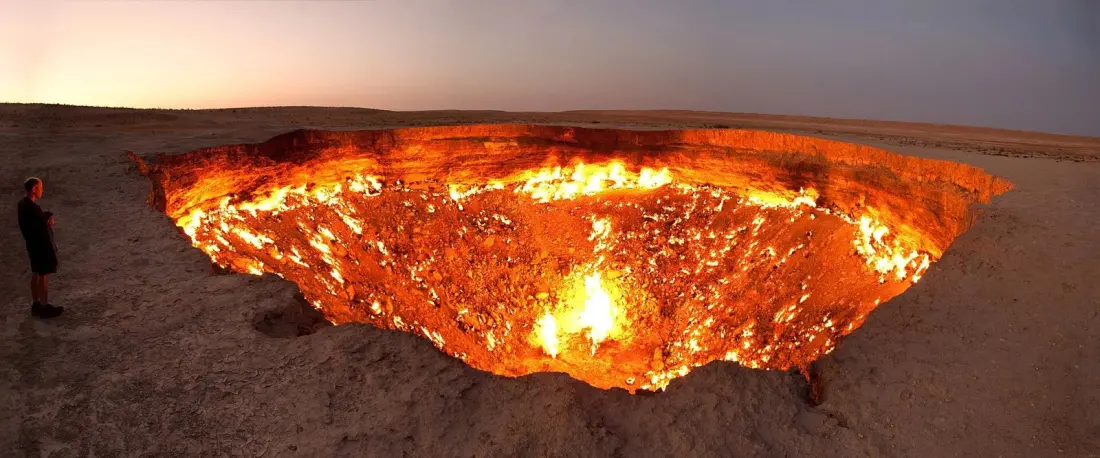
In the middle of Turkmenistan's Karakum Desert, a crater has been on fire for more than 50 years. By day, the Darvaza gas crater is a huge pit in the sand, roughly 60-70 metres wide and about 30 metres deep. After dark it glows orange, which is how it earned the nickname the Door to Hell. That glow, though, is starting to fade.
Visitors in 2025 reported only scattered patches of flame where a much larger blaze once raged. The reason is deliberate: Turkmenistan's state gas company, Turkmengaz, has been drilling new wells and reopening old ones around the site to capture the methane that has fed the fire since the 1970s. It's an environmental move as much as anything — methane is a potent greenhouse gas, so simply snuffing the flames wouldn't help if the gas kept escaping. The stated goal is to divert the gas away from the crater entirely and end the uncontrolled emissions for good.
The crater's origin story is suitably murky. The standard account says Soviet geologists drilling for gas in 1971 broke through into an underground cavern, and engineers lit the escaping methane expecting it to burn out within days. It didn't. Explorer George Kourounis, who descended into the crater in 2013 wearing heat-resistant gear and a breathing rig, was told during that expedition the collapse may have happened earlier, with the ignition years later. Records have never fully settled it. What is documented is his 17 minutes on the crater floor collecting soil and gas samples, part of an expedition that took two years to prepare — and a study of whether microbes could survive down there.
The timing for travellers is bittersweet. Turkmenistan has long been one of the hardest countries to visit, but it has recently introduced electronic visas and dropped the requirement for a formal invitation letter, even though travel is still tightly controlled. Just as the door opens to more international visitors, the attraction many of them came for is losing its spectacle. The crater isn't going anywhere — but the fire may simply dwindle rather than go out dramatically. If seeing one of the world's strangest sights while it's still burning is on your list, sooner beats later.