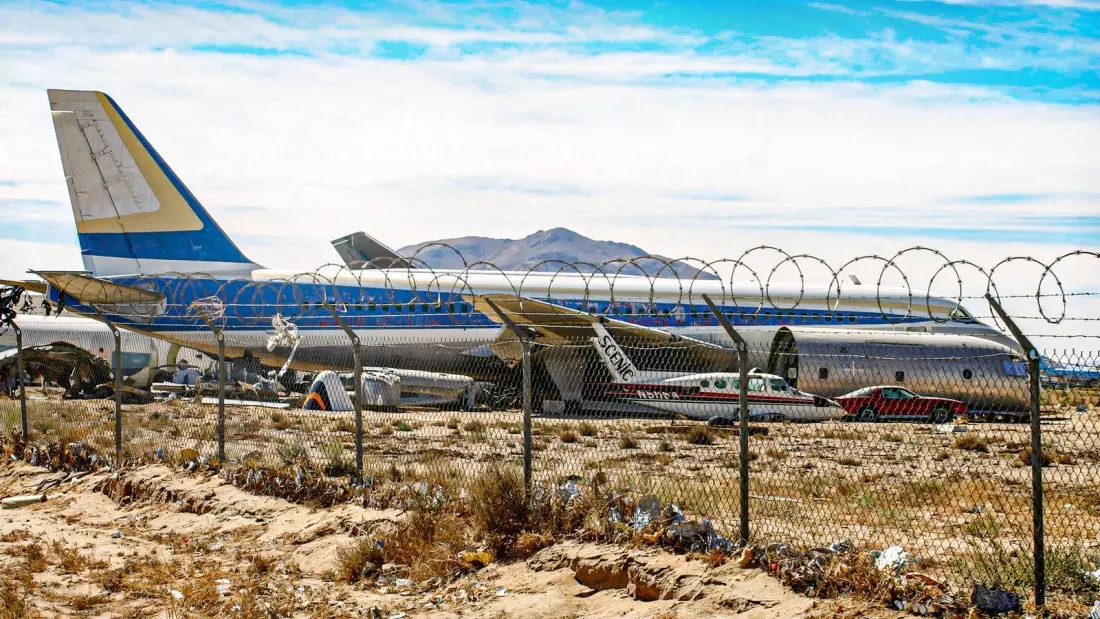
About 100 miles north of Los Angeles, the Mojave Air & Space Port doubles as one of the world's best aircraft storage sites — and among its rows of parked jets are the last survivors of one of aviation's great commercial failures: the Convair 880 and 990.
Convair was a giant of 1950s American aviation, behind the B-24 Liberator, the B-58 Hustler bomber and a string of fighter jets. Confident from military success and roughly 1,200 piston-engined feeder liners delivered, the company took on Boeing and Douglas directly in the jet age. Its pitch: a smaller, faster medium-range jet than the 707 or DC-8. The 880 cruised at around 615 mph — 25 to 35 mph quicker than its rivals — with five-abreast seating and a luxury feel. The stretched 990 carried 122–137 passengers and topped 620 mph, with distinctive 'speed pods' on the wings to cut drag.
Speed, though, meant thirst. When the 1973–74 oil crisis hit operating costs, TWA — the largest operator — flew its last 880 service on 15 June 1974. Only 65 examples of the 880 and 37 of the 990 were ever built, and the program cost parent company General Dynamics $185 million at the time, well over $1.5 billion in today's money. The planes found second lives instead: one 880 became a Navy and FAA test aircraft supporting Tomahawk cruise missile operations, while NASA flew a 990 at Edwards to test Space Shuttle landing gear and brakes — work that let the Shuttle's crosswind landing limit rise from 15 to 20 knots.
Mojave's dry, low-humidity climate makes it ideal for storing airframes, and airlines still park Boeing, Airbus and McDonnell-Douglas jets there for refurbishment or scrapping. Airport Spotting has identified five Convair 880/990 airframes surviving at the field, including three complete 880s. One — NASA's CV-990 #810 — stands as the gate guardian at the entrance, a rare chance to see this failed jetliner up close. For aviation fans driving out to the desert, it's a memorial to a bet Convair lost, and to how quickly jet-age fortunes could turn.