If you want to see the Guerewol, the Wodaabe people's remarkable annual gathering of courtship dances and ceremonies in the Sahel, you'll need to accept one inconvenient truth: nobody can tell you the exact dates in advance. The festival follows the pastoral calendar, not Google's.
The Wodaabe are a cattle-herding people within the wider Fulani world, and their gatherings happen after the rains end, when pasture and water have allowed families dispersed across the Sahel to reconcentrate. In Chad, that usually means late September or early October, near Durbali (also written Dourbali) in the Sahel region southwest of the capital N'Djamena. But even that is a rough guide: Durbali is a geographical reference, not a venue. The actual ceremonies happen wherever the participating communities have pitched their camps, which shifts with grazing conditions each year.
Anthropologist Nikolaus Schareika's 2003 research for the UN's Food and Agriculture Organization documented how Wodaabe life in southeastern Niger revolves around two seasons — ndunngu (fresh vegetation during the rains, roughly June/July to September) and seedu (the dry period). The end of the rains is what makes a large gathering viable; a dry year or late rainfall can push everything around.
There's also no central organising body. Community elders coordinate arrangements, and tour operators maintain contact with local groups to anticipate when and where things will happen — which is why a trip advertised for late September is built around an expected gathering, not a published programme.
Travellers often confuse the Guerewol with Niger's Cure Salée, a broader official pastoral festival near In-Gall, west of Agadez, that draws Tuareg and Wodaabe communities alike. Niger's 2026 Cure Salée is a cautionary tale: the Ministry of Agriculture and Livestock scheduled the 59th edition for 25–27 September, then moved it to 2–4 October less than three weeks out. If a government-backed festival can shift, imagine a community-run one.
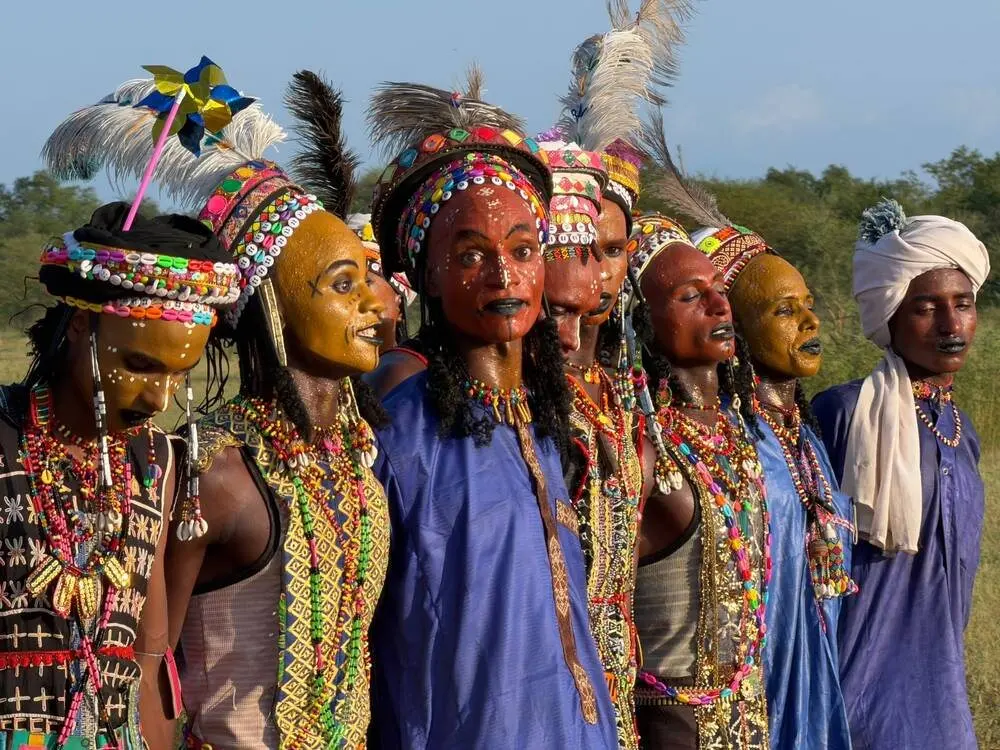
And don't expect a week of non-stop spectacle. The gathering lasts around seven days in total, with family meetings, lineage business and quieter stretches between the famous courtship dances — the Yaake, Ruume and Geerewol — in which men line up in elaborate face paint, jewellery and feathered ornaments, emphasising their eyes and teeth while female judges assess them. It's often called a male beauty contest, but that flattens what is really a complex social event tied to courtship, marriage negotiations and relationships between lineages. Visitors are attending a living cultural gathering, not a show put on for tourists, so patience and a respectful local guide matter more than a camera.
Bottom line: if the Guerewol is on your list, plan for late September into early October, book through an operator with genuine local contacts, and build in flexibility. The reward is one of the most extraordinary cultural events on the continent — you just have to find it first.