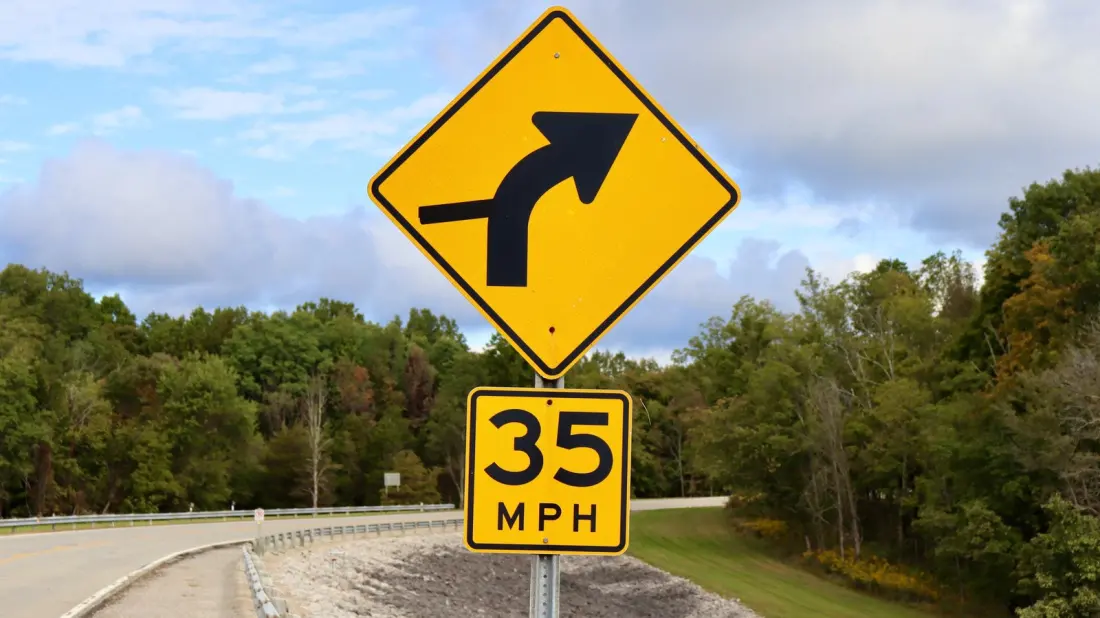
A bright yellow diamond with a black arrow and a number like 25 on it appears just before a sharp bend, and plenty of drivers aren't sure whether it carries the same weight as a regular speed limit sign. The short version: it's an advisory speed sign, not a legal limit, but ignoring it on an unfamiliar road is a quick way to ruin a road trip.
These signs show up where the general posted limit stops being sensible. If a highway section is signed 45 mph but the curve ahead is tight, engineers will post an advisory speed well below it. The same signs appear on on-ramps and off-ramps, before bridges, on mountain passes and approaching roadworks. Placement and use are governed by the Manual on Uniform Traffic Control Devices (MUTCD), which requires the sign to give drivers enough run-up to read it and react.
The numbers aren't guesses. To set an advisory speed, engineers run a ball-bank indicator test: a device is fixed to a vehicle, which is driven through the curve at various speeds. A steel ball in a curved, liquid-filled tube shifts with the sideways force the corner generates, and that data tells engineers the fastest safe speed for the bend. Curves are signed in both directions, so the advisory works whichever way you're travelling.
Legally, exceeding an advisory speed isn't a violation in itself — the posted black-and-white limit is what police enforce. But that doesn't make the yellow number optional in practice. If you're going too hot into a bend and lose control, other charges can follow, and the physical consequences are the same either way. The obvious move when a curve with a reduced number appears: brake before the corner, not in it, and take the bend at or below the advisory.
Motorcyclists get extra value from these signs. A rider who spots an advisory early can downshift, set an entry speed and position their body before leaning into the turn, which makes for a far more controlled line through the bend than discovering it mid-corner. Drivers of campervans and vehicles loaded with holiday luggage should also take the numbers seriously — higher centre of gravity and extra weight both make the safe speed lower.
Why does this matter for travellers? Because advisory signs cluster exactly where rental-car drivers are most out of their depth: scenic mountain routes, coastal highways and winding rural roads — the drives people specifically plan trips around. On a road you've never seen, the yellow sign is a free piece of local knowledge, tested by engineers, telling you what the corner ahead will punish you for getting wrong. Treating it as a suggestion rather than decoration is one of the simplest safety habits you can build before a big driving holiday.