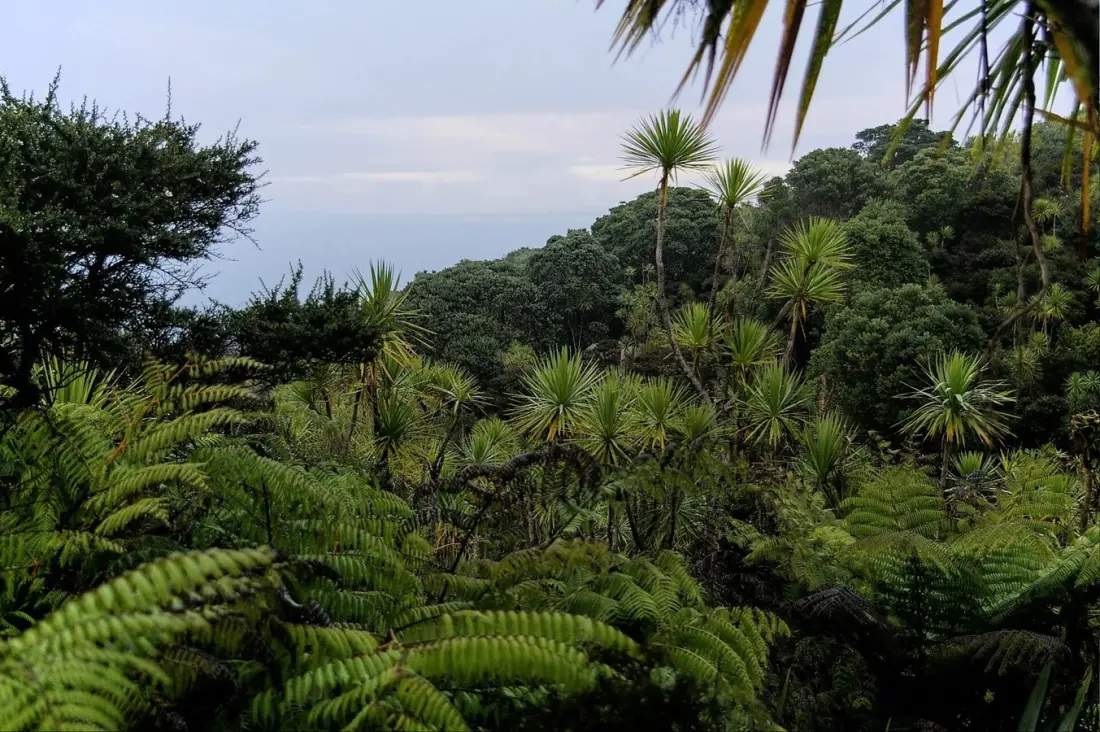
Forty minutes' sail from Auckland, Tiritiri Matangi looks like the Hauraki Gulf has always sounded this loud with birdsong. It hasn't. When grazing finally stopped in the 1970s, almost none of the island's original forest was left. What you walk through today is the result of one of the world's most successful volunteer restoration projects.
The replanting ran from 1984 to 1994, and it was hands-on. Scientists John Craig and Neil Mitchell of Auckland University got the ball rolling; seeds were gathered from surviving plants on the island and nearby, then raised in an island nursery run by Ray Walter, the last lighthouse keeper, with his wife Barbara organising the crews. Schoolchildren, tramping clubs and families made the crossing to plant — at one point there was a waiting list just to get a spade. In total, volunteers put more than 280,000 native trees into the ground, deliberately leaving some open ground for grassland-loving wildlife. The Supporters of Tiritiri Matangi, formed in 1988, still helps run the place alongside the Department of Conservation and iwi.
The birds came next, in stages. North Island saddlebacks (tīeke) arrived in 1984, the last mammalian predator — the Pacific rat, or kiore — was removed in 1993, hihi (stitchbirds) followed in 1995 and kōkako in 1997. Now the island is predator-free and packed with species that are hard or impossible to see on the mainland. Takahē, the stocky flightless rail once thought extinct, graze in the open near the lighthouse, which is about as close and easy a viewing as you'll get anywhere.
For walkers, there's a simple choice. The Kawerau Track gives you the full story: coast, young replanted bush, then a surviving patch of old forest that shows what the crews were aiming at. The shorter guided Wattle Track is better if you'd rather stand at a sugar-water feeder and wait — a hihi darting in for a drink is a real possibility. The trees themselves are part of the attraction; plenty were seedlings dug in by weekend volunteers a generation ago.
Practicalities are straightforward but worth respecting. Explore Group sails from Auckland's Viaduct Harbour via Gulf Harbour — roughly 80 minutes from the city or 25 from Gulf Harbour — and you should book ahead between November and April. Add a volunteer-guided walk to your ferry booking, or follow the marked tracks yourself. Bring lunch and water, use sealed containers, check your bag for stowaway insects and brush seeds and soil off your shoes before boarding. That last bit isn't fussiness; the whole island works because nothing predatory or weedy gets across the water.
Who is this for? Anyone with a day to spare in Auckland who wants something genuinely different from a city itinerary: families (kids can handle the short tracks easily), birders chasing species they won't see elsewhere, and anyone curious what determined volunteering can actually achieve. Give yourself a few unhurried minutes near a feeder on the way back to the wharf — that's often where the best moment of the day happens.
Story reported by Getaway South Africa.