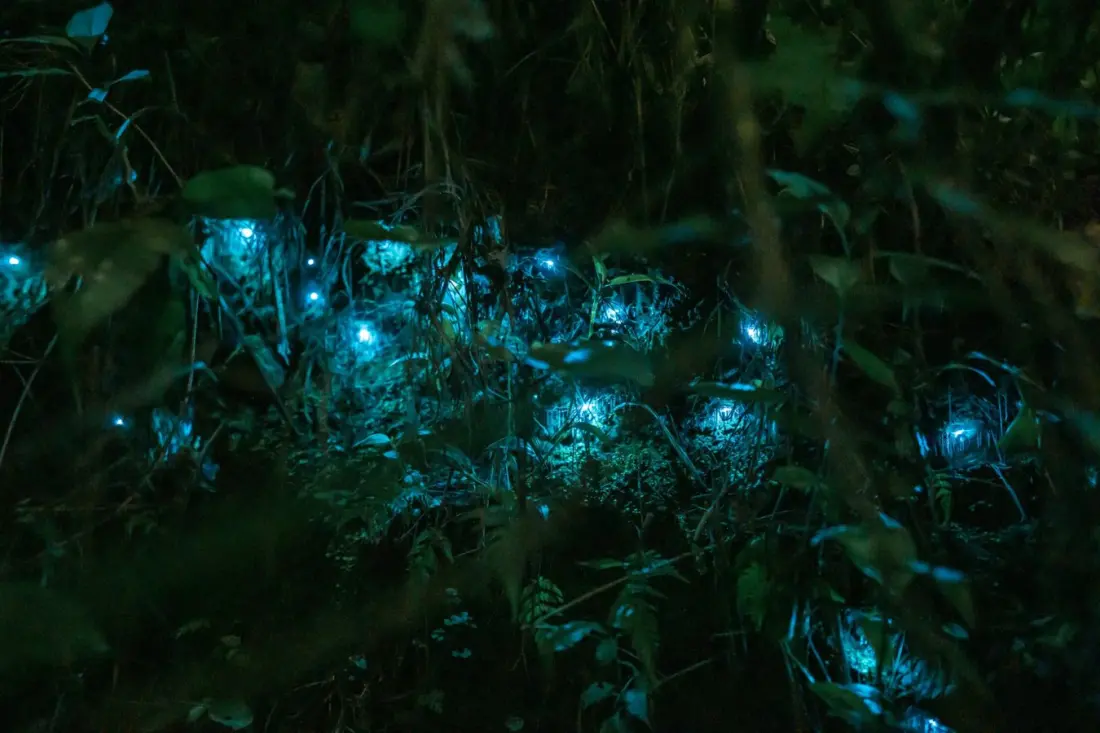
Picture drifting through a pitch-black cave, looking up at what seems like a star-filled sky — except it's thousands of tiny blue-green larvae glowing on the ceiling above you. New Zealand's glowworm caves turn stargazing upside down, and they're among the country's most memorable natural experiences.
The performers here aren't worms at all. They're the larvae of Arachnocampa luminosa, a fungus gnat found nowhere else on Earth. Their blue-green light, produced by bioluminescence, has a dark purpose: it's a fishing lure. Each larva dangles silk threads up to 50cm long, coated in sticky mucus. Insects mistake the glow for daylight at a cave mouth, fly towards it, and get snagged on the lines. That glittering canopy is essentially an elaborate insect trap.
The most famous site is Waitomo, in the Waikato region of the North Island, which has drawn visitors for more than 130 years. Māori chief Tane Tinorau and English surveyor Fred Mace explored the caves extensively in 1887, floating in on a flax-stem raft by candlelight. By 1889, Tane Tinorau and his wife Huti were guiding tours — and in 1989 the caves and land were returned to the descendants of the original Māori owners, many of whom work there today. Modern tours walk you through limestone caverns before a boat carries you into the darkened Glowworm Grotto, where the only light comes from above. The wider network includes Ruakuri Cave, with dramatic formations, and Aranui Cave, known for its stalactites and stalagmites.
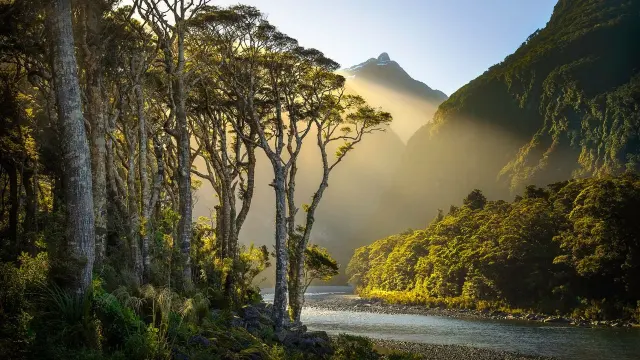
On the South Island, Te Anau offers a different version of the experience. It starts with a cruise across Lake Te Anau to the western shore, beneath the Murchison Mountains. These caves are geologically young — roughly 12,000 years old — and still being carved by the Tunnel Burn stream, which creates whirlpools, narrow passages and underground waterfalls. The finale is a small-boat drift into a hidden grotto lit by hundreds of glowworms.
One rule applies everywhere: no photography. Artificial light disturbs the glowworms, and caves are fragile environments where humidity and airflow matter to their survival. Guides ask visitors to keep quiet and leave torches and phones off. In an age when everything gets filmed, that enforced darkness is oddly refreshing — you just look up.
A few practical notes: you don't need to go at night, since the caves stay dark all day. Te Anau's caves sit around 8–12°C, so bring a warm layer. Paths can be damp and slippery with low ceilings, so wear decent shoes. And book ahead — Waitomo gets very busy in holiday periods.
For travellers, this is an easy add-on to any New Zealand itinerary: Waitomo pairs well with a North Island route between Auckland and Rotorua, while Te Anau slots neatly into a South Island trip towards Fiordland and Milford Sound. Both deliver something you won't see anywhere else in the world — because the species that makes it happen exists only here.