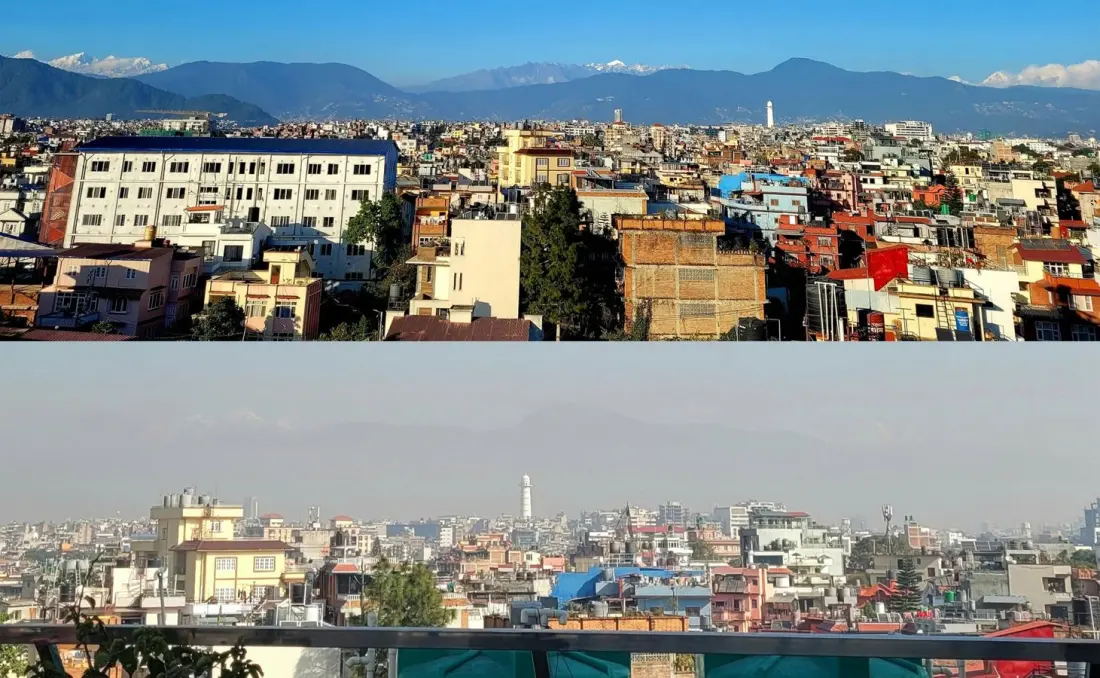
Every winter, a familiar problem returns to Nepal: smoke. As the monsoon recedes, a grey veil settles over Kathmandu and the hills, and mountain views — the whole reason many visitors book the trip — disappear behind it. This year started better than most, thanks to unusually late October and November rains, but mornings in Kathmandu Valley are already hitting AQI readings around 134, a level considered unhealthy, and the numbers typically climb through the dry months ahead.
The numbers behind the haze are striking. Nepal's annual average PM2.5 concentration sits at roughly 40-50 micrograms per cubic metre, about eight times the World Health Organization's guideline of 5 μg/m³. Fine particulates are the main culprit in Kathmandu, fed by vehicle exhaust, brick kilns, open garbage burning, post-harvest agricultural fires, and a regional soup of pollution drifting up from the Indo-Gangetic Plain, including stubble-burning smoke from Punjab after the Tihar festival season.
Geography makes it worse. A winter temperature inversion traps a layer of warm, dirty air under colder air above, so pollution pools in the valley instead of dispersing. The practical consequence for travellers goes beyond hazy photos: poor visibility disrupts flights, with aircraft stacked up waiting to land at Kathmandu, Pokhara and Tarai airports. Hoteliers report the fallout first-hand. Ishwar Basnet of Tiger Mountain Hotel in Pokhara says international guests — photographers in particular — complain every year when they arrive during peak pollution season and the peaks simply aren't there, leaving them feeling short-changed.
There is one genuinely bright spot. Kathmandu's 2026 annual PM2.5 reading of 21 μg/m³ so far is 52% lower than the average of the past six years, making this the cleanest stretch in that period, largely thanks to delayed rains. The Tarai has improved too, though a World Bank analysis attributes 67% of its PM2.5 to cross-border sources — meaning it bears the brunt of pollution Nepal can't control. Environmental engineer Bhusan Tuladhar notes that electric vehicle adoption has trimmed nitrogen oxides and cleaner household fuel has cut sulfur dioxide, but not by enough to shift overall levels. The catch, he points out, is that the unseasonal heavy rain bringing this relief is itself a symptom of climate change — temporary respite, not a fix.
For anyone planning a Nepal trip, the takeaway is simple: timing matters. December to February bring crisp cold but also peak haze in the valley and flight delays. If mountain panoramas are the point of your trip, consider autumn trekking season, build buffer days into any domestic flight itinerary, and treat Pokhara or hilltop viewpoints as a second chance at the view rather than a guarantee. Air quality is still classified as a health risk by the WHO even in a good year, so travellers with respiratory conditions should pack accordingly and check daily AQI readings.