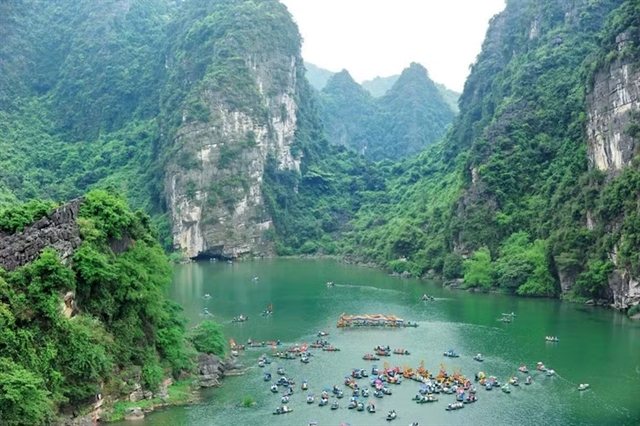
The cone-and-tower karst of Tràng An in Vietnam's Ninh Bình province has landed a spot on the International Union of Geological Sciences' third list of the world's 100 best geological heritage sites, released for 2026. It's the third time the area has made the cut — a nod from the scientists rather than the travel magazines, which is arguably the rarer prize.
Registered as site No. 283 in the landforms and ongoing geological processes category, Tràng An is what geologists call a mature tropical karst. In plain terms: millions of years of rainwater dissolving limestone created a maze of connected cones, isolated stone towers, enclosed depressions and fault-guided channels — then the sea moved in and out several times, leaving erosion notches, wave-cut platforms, beach deposits and shell layers now stranded well above the waterline. The land you walk (or boat) through today actually emerged thanks to tectonic uplift, coastal sediment and a thousand years of human dyke-building.
People have lived here since ancient times, though formal scientific study only started in the late 19th century. Vietnamese-British research projects are still working on the site. UNESCO added Tràng An to its World Heritage List back in 2014 as a mixed cultural and natural site, recognising both the geology and the long relationship between locals and the landscape. Since then, the accolades have stacked up: praise from Insider in 2018, Forbes in 2023 and Tripadvisor in 2025.
For context on how exclusive this list is, Tràng An sits alongside Mount Fuji in Japan, Norway's Kongsberg silver mines, the Andean structure at Cerro Aconcagua in Argentina and the Chocolate Hills of Bohol in the Philippines. That's the company it keeps.
Why should a traveller care? Because the geology is exactly what makes a boat trip here so striking: you glide through flooded cave tunnels between sheer limestone towers, past temples and patches of golden rice paddy, all within a couple of hours of Hanoi. It's often dubbed "Halong Bay on land", but with fewer crowds at many of its landing sites and a deeper cultural layer — ancient capitals, pagodas and dyke systems humans built to hold back the sea. If you're planning a northern Vietnam itinerary, this latest international nod is a good excuse to give Ninh Bình more than a day trip.