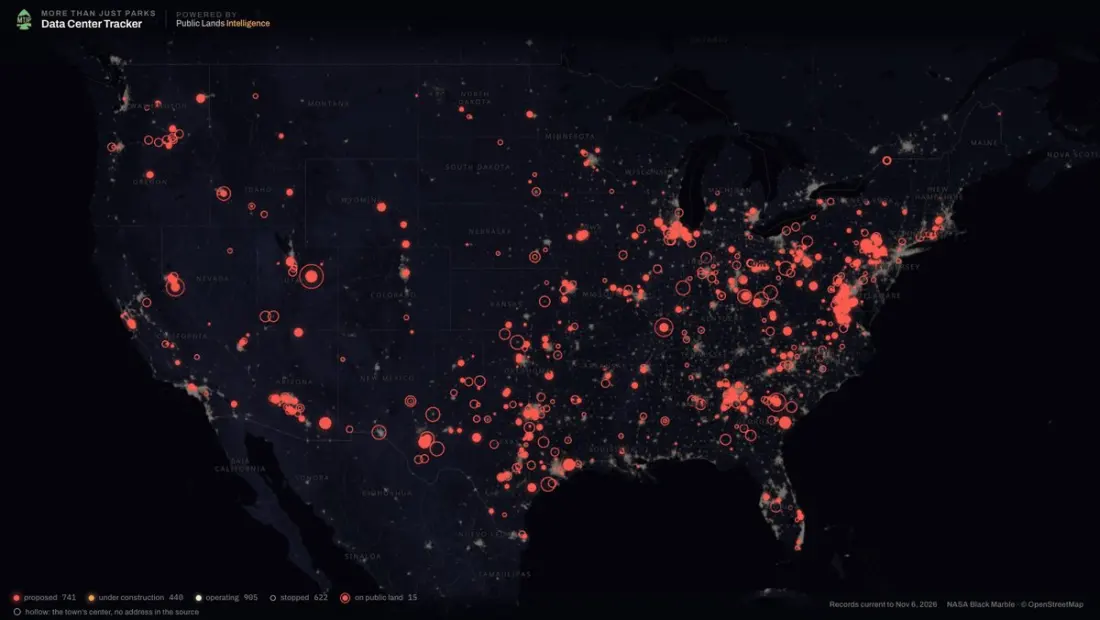
The trailhead parking lot might soon have a new neighbour: a server farm. A free interactive map from More Than Just Parks, an independent public lands publication, lets anyone type in a zip code and see the nearest AI data centre — existing or proposed — along with its expected impact on utility costs and the groups backing it.
The numbers behind the tool are striking. Will Pattiz, the publication's cofounder, has tallied at least 14 proposed projects within ten miles of a national park boundary, 38 within 25 miles, and 131 within 50 miles. The map currently tracks 2,086 data centres nationwide, 741 of which are still in the proposal stage. Of those, 77 sit within ten miles of protected land such as parks, wildlife refuges and conservation areas — and roughly half are in the American West.
Some proposals press right up against the icons. In Page, Arizona, the city sold about 500 acres — previously protected for outdoor recreation — to developers planning a $10 billion data centre beside Horseshoe Bend, the famous Colorado River viewpoint. The site also sits roughly five miles from the northeastern edge of Grand Canyon National Park near Lees Ferry. The project is still in public review, with a planning and zoning meeting scheduled for November 17.
Utah features heavily. Near Price, a company called Valar Atomics has applied for more than 9,000 acres of Bureau of Land Management land for what's known as Project Beehive — a buildout that would include hundreds of small nuclear reactors, a fuel plant and nuclear waste storage, producing about 9.6 gigawatts for data centres. That's more than double what the entire state currently generates, according to NPR. The land sits about two hours from both Arches and Canyonlands national parks. Further south, the Antelope Data Center, part of a 640-acre, 1.5-gigawatt project with an on-site natural gas plant, is slated for Iron County, about 40 miles from Zion National Park.
The concern for hikers and road-trippers is straightforward: data centres consume enormous amounts of electricity and water, and Pattiz argues many are approved quietly, with little public benefit outlined. Virginia has 97 proposed centres, 12 within 25 miles of Shenandoah National Park, while Indiana has at least 25, eight within 25 miles of Indiana Dunes.
If you care about dark skies over the Colorado Plateau or quiet trailheads in the Appalachians, this is worth a look — not as alarmism, but as a way to see which proposals near the places you visit are genuinely moving forward, and to weigh in during public comment windows before ground is broken. Pattiz's point isn't that the centres shouldn't exist; it's that the public should know where they're going and what they'll cost the places people love.